Vintage Halloween Collectibles: German Candy Containers, Die-Cuts and Boxed Costumes
- Project
- Toys & Action Figures
- Drawn by
- Brenda Kelley Kim
- Issued
- Sheet
- A-211
Fragile German paper-mâché, vintage die-cuts and boxed costumes reward close inspection, with condition and maker details shaping their appeal.
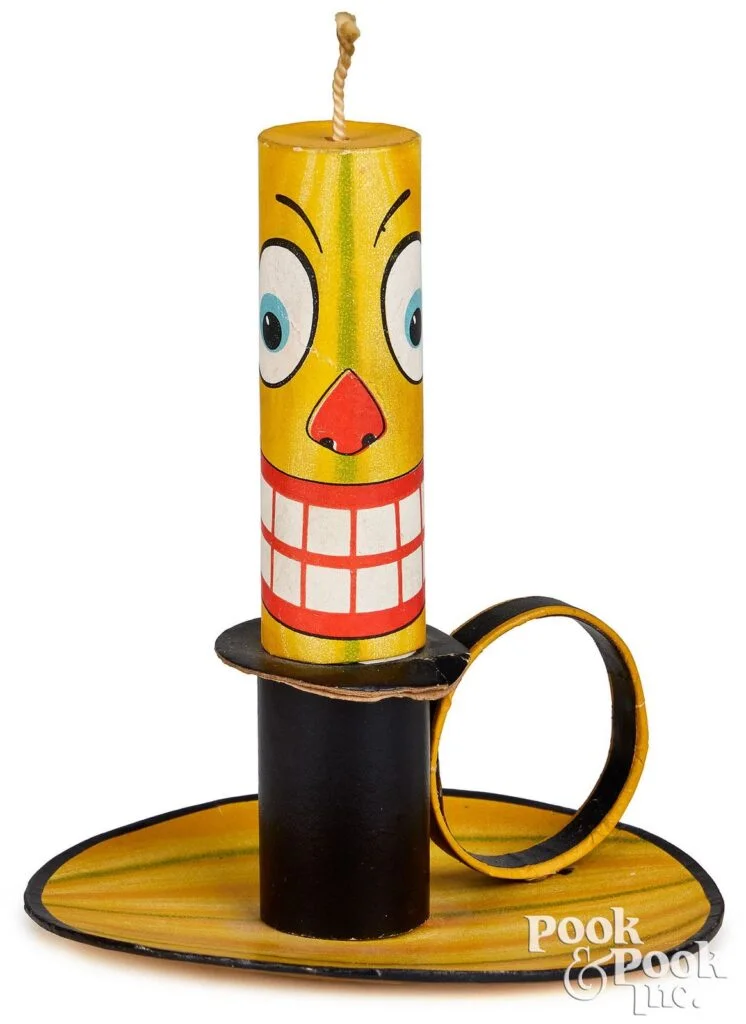
Vintage Halloween pieces offer a compact record of how the holiday’s decorations and costumes changed over time. German paper-mâché candy containers, Beistle’s die-cut designs and boxed costumes from Ben Cooper and Collegeville each have their own collecting challenges. Age and condition matter, but so do maker marks, construction details and the survival of fragile parts.
German paper-mâché: candy containers and lanterns
German artisans made novelty paper-mâché candy containers in the 1920s and 1930s, often shaping them as witches, pumpkins and other spooky figures. These were holiday treats in their own right, made to hold candy and add some spectacle to Halloween. Since the pieces were made of paper, many were discarded after use or damaged over time. That scarcity makes condition a central part of assessing one today.

A second sale shows how sharply results can differ between examples. A German Halloween container dated 1916–1921 sold for $338 in 2023. The source identifies it as the same item shown above, but in less comparable condition. Wear may help explain the gap, though the survival of these delicate objects also shapes what collectors can find.

Some containers had a second purpose: once emptied, they could serve as Halloween lanterns at a home’s doorway. Other paper-mâché figures were made for display, as table decorations or holiday centerpieces, rather than for candy. The range is worth remembering when identifying a piece; a figure’s shape alone may not tell you how it was intended to be used.
Marolin, a German maker that began with figurines—many of them nativity figures—expanded into decorations for other holidays, including Halloween. Its pieces were made using a closely guarded formula. The firm’s name is associated with animal figures, nativity sets, décor and novelty candy holders, and the surviving Halloween figures remain sought after.


Marks and materials help separate old from new
For paper-mâché pieces claimed as German-made, look for factory markings or the word “Germany” on the object. Japan also produced these decorations in larger quantities as their popularity grew, while some collectors favor the hand-painted, artisan-made German work from before 1940. The material deserves close attention: reproductions may be painted cardboard rather than hand-crafted paper-mâché. The source says reproductions fluoresce under long-wave black light, while vintage examples usually do not. That can inform an inspection, alongside construction, paint and markings.
Beistle die-cuts and Dennison’s Bogie Books
Cardboard and pressed-paper decorations brought Halloween designs to doors, windows and walls. The Beistle Company has made Halloween décor since the 1920s, but its continued use of original designs means appearance alone can’t establish a piece’s age. M. L. Biestle founded the company in 1900 after seeing manufacturing methods in Heidelberg, Germany. He developed a process for tissue-paper honeycomb designs before expanding into die-cuts; Halloween pieces were the first holiday items in the company’s catalog.

Collectors comparing Beistle originals with later reissues should inspect the details. Older die-cuts may be embossed and may retain price stickers; newer examples are typically glossier and printed on both sides. Those clues help build an attribution, though a single feature shouldn’t carry the whole identification.
Dennison made Halloween paper figures and party supplies, and its Bogie Books became a distinctive part of the company’s output. Published from 1909 to 1935, the books combined product catalogs with stories, party ideas and games. Dennison issued books for other holidays too, but Halloween editions were the most popular and the only holiday titles published every year.

Boxed costumes capture mid-century pop culture
By the mid-century period, many children’s costumes came in boxes with a mask and a vinyl tunic or smock. Ben Cooper, which had earlier made theatrical and vaudeville costumes, moved into the pop-culture market by the 1950s. The company licensed Disney characters, and some early masks were assembled from gauze and fabric before plastic became the standard. In the mid-1960s, Beatles costumes joined the range, including outfits representing Ringo.

Collegeville competed for character licenses with television favorites including Woody Woodpecker and Casper the Friendly Ghost. Ben Cooper closed in the late 1980s, and Collegeville followed in the mid-1990s. The source ties their decline to changing preferences for latex masks and more realistic outfits. Many boxed sets were simply thrown away as children outgrew them, making complete surviving examples harder to find.
What to check in a newly found piece
Today, boxed Ben Cooper and Collegeville costumes are collected and displayed as well as admired for their original purpose. For any attic or closet discovery, start with the maker, materials, markings and condition. A paper-mâché figure’s age and delicate finish, a die-cut’s embossing and printing, or a costume’s mask and packaging can all help place it in context. Comparable sales can add useful reference points, but the examples here show why condition and completeness deserve careful attention.
For additional reference, the WorthPoint Price Guide, Dictionary and Marks database are linked resources for researching collectibles.
Brenda Kelley Kim lives in the Boston area. She is the author of Sink or Swim: Tales From the Deep End of Everywhere and writes a weekly syndicated column for The Marblehead Weekly News/Essex Media Group. When not writing or walking her snorty pug, Penny, she enjoys yard sales, flea markets, and badminton.
WorthPoint—Discover. Value. Preserve.
The post Vintage Halloween Collectibles: German Candy Containers, Die-Cut Décor, and Boxed Costumes appeared first on WorthPoint.
| Rev | Description | Date |
|---|---|---|
| A | Issued for reading | |
| B | Viewed 387 times | Current |