Victorian Human Hair Watch Chains: Mourning Jewelry, Details and Auction Results
- Project
- Stamps & Postal History
- Drawn by
- WorthPoint
- Issued
- Sheet
- A-220
Woven from a loved one’s hair, Victorian watch chains paired personal remembrance with everyday wear. Recent sales ranged from $72 to $387.50.
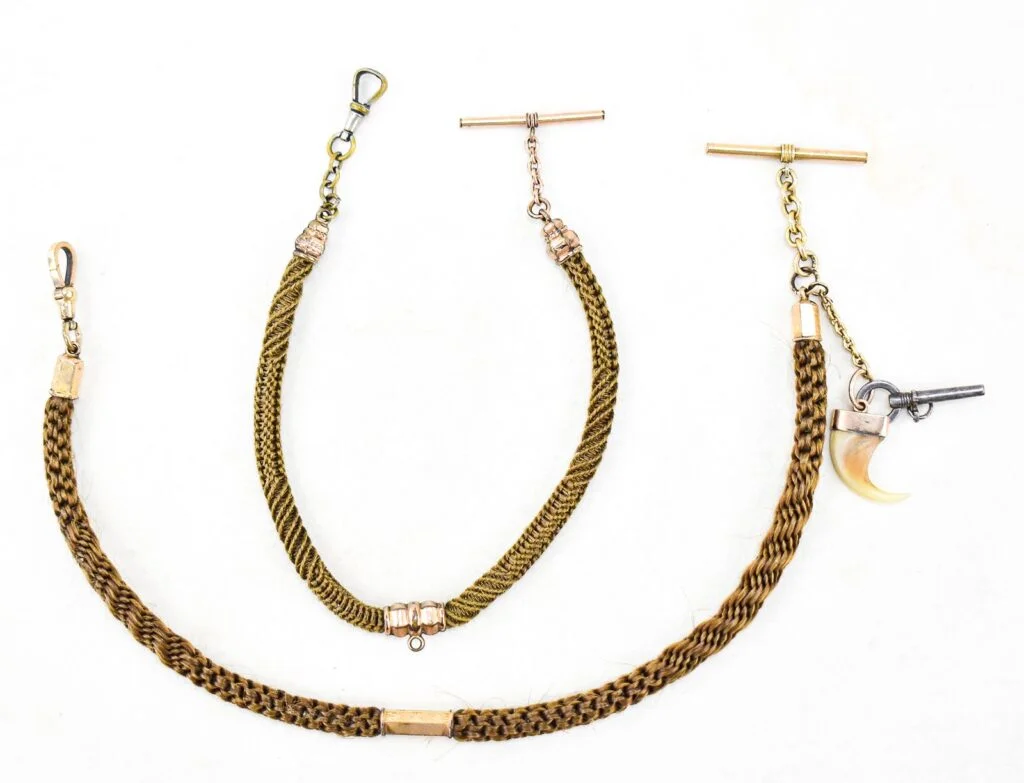
These Victorian watch chains carried a pocket watch and a personal remembrance in the same piece. Made by braiding human hair, they were wearable mourning jewelry: close to the body, visible across a waistcoat, and tied to the memory of someone who had died. Recent auction results show a range of prices for examples with different materials and details, while condition and original fittings remain useful points for collectors to examine.
Reading the details of the chains
The pair pictured here includes two braided chains made from human hair. One measures about 17 inches and has gold-tone brass clasps, small T-bars and accent beads; a crescent-shaped charm hangs from one end. The clasps and T-bars are functional parts of the watch-chain assembly, while the charm gives the piece an additional decorative detail. The pair is described as intact, with the braiding still legible.

A Victorian man typically wore a watch chain across his waistcoat, attaching a pocket watch at one end. That placement made the chain practical, but a hairwork example also served as a private memorial carried in daily life. A period image of a gentleman wearing a chain helps show how the accessory sat on the waistcoat.

Hairwork as personal mourning jewelry
Victorians made jewelry from a loved one’s hair after a death, creating objects associated with a particular loss. These pieces are often grouped with memento mori jewelry, a phrase meaning “remember you must die,” though Victorians more often called such objects mourning jewelry.
The practice expanded during the 1860s, following Prince Albert’s death in 1861 and Queen Victoria’s prolonged grief. Hairwork appeared in chains, bracelets, brooches and rings. Professional hairworkers made some pieces; others were made at home, often by women in mourning. The braiding demanded patience, and its handworked character set it apart from mass-produced jewelry. Since these objects were intended to be worn, the memorial remained physically close to its owner.
For today’s collector, the construction offers a way to look closely at a piece. Note the condition and legibility of the braid, whether clasps and connectors are present, and what materials the fittings appear to use. The source describes some comparable chains as having gold-filled accents, while the pictured pair has gold-tone brass fittings. Those descriptions are not interchangeable, so material claims should follow the evidence available for each specific object.
A shift in custom and fashion
Mourning practices had begun to relax before 1914, and the First World War accelerated the shift. In Britain, families faced widespread loss, including deaths that could not be confirmed or recovered. Extended public mourning became more difficult to maintain. As many women entered the workforce, the hours needed to make intricate hairwork were also harder to find. The craft remained popular into the war period, then receded from fashion.
Hairwork now tends to surface in estate sales, liquidations, antique booths and auctions, rather than through the shops that once sold mourning jewelry. Its rarity in everyday retail settings makes identification details especially useful when a chain turns up among mixed jewelry or household objects. The waistcoat style, braided hair, watch fittings and any accompanying charm can help tell its story.
Recent auction results
The pictured pair sold through McLaren Auction Services on October 8, 2026, for $300. It comprised two intact chains with clasps and connectors; the braid remained legible, and the fob added another element to the set. Heritage Auctions sold a Victorian enameled hair watch chain for $387.50 on October 20, 2026.

Other reported results were lower: Sphere Auctions sold a Victorian human hair watch chain for $72 in May 2026, and Gemini Auctions sold a similar chain for $87.50 in March 2026. Both had gold-filled accents. These results show that examples described as similar can still sell at notably different prices. The source points to complete condition and original gold hardware as features that tend to draw stronger interest among collectors of Victorian mourning pieces. Each result remains specific to the object and sale; it does not set a fixed value for other chains.
When assessing a newly found example, record its length, fittings, decorative elements and condition, and compare it with documented sale examples that share those features. For this personal form of Victorian jewelry, the braid and hardware are more than finishing details: they help establish what survives of the original object.
| Rev | Description | Date |
|---|---|---|
| A | Issued for reading | |
| B | Viewed 677 times | Current |