Madballs Collecting Guide: Series, Rare Finds and Recorded Sales
- Project
- Toys & Action Figures
- Drawn by
- Adina Francis
- Issued
- Sheet
- A-38
From 1985’s rubber monsters to Super Madballs, condition, packaging and scarcity shape the market for these gross-out classics.
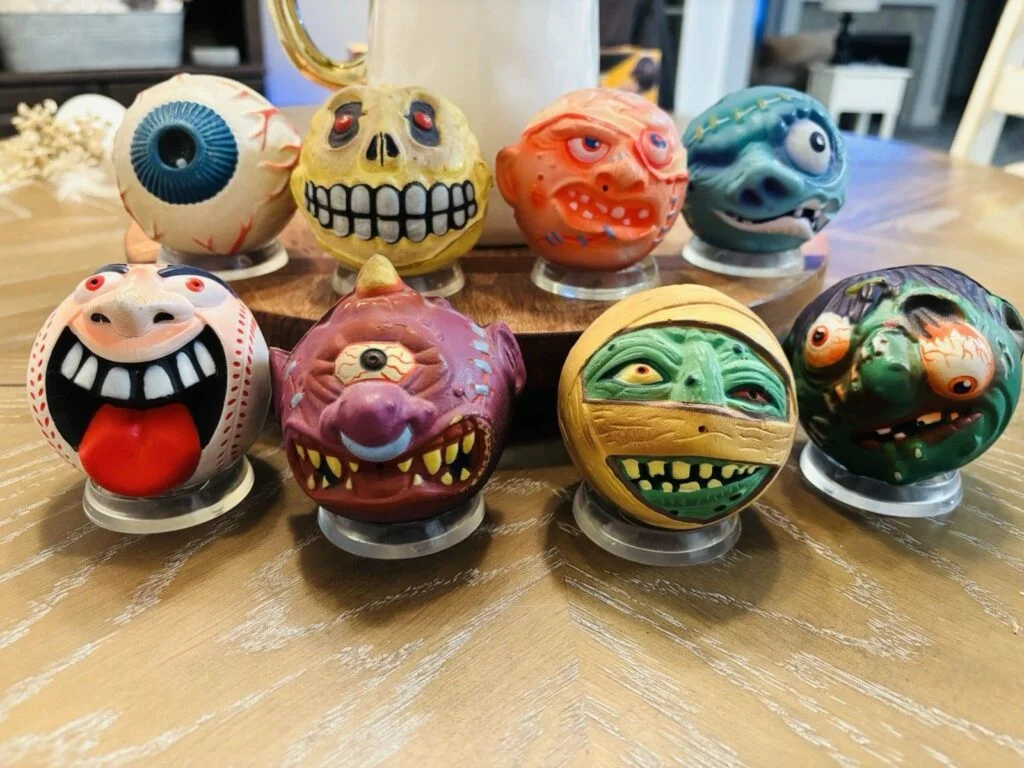
Madballs turned deliberately ugly faces into a hit collectible, and today the line’s appeal reaches well beyond its original tennis-ball-sized toys. Series 1 and 2, sports-shaped Super Madballs, spring-loaded figures and short-lived accessories all offer distinct collecting paths. The details that matter most are the character, series, material, condition and whether original packaging survives.

From AmToy launch to a wider franchise
American Greetings’ Those Characters From Cleveland had already built an audience with Care Bears and Strawberry Shortcake, lines that largely appealed to girls. The company saw room for something aimed at boys drawn to gross-out humor, in the same broad moment as Topps’ Garbage Pail Kids. The result was Madballs: monster faces sculpted into balls, with none of the cuddly charm of the company’s other popular characters.
American’s toy division, AmToy, launched the first Madballs in 1985 at $3.99 each, followed by a global rollout in 1986. The original eight Series 1 characters were made from denser rubber. Among them were Aargh, a Frankenstein-like monster, and Slobulus, a green drooling creature with an eye hanging from its socket.
Their rebellious look helped the toys stand out. Madballs were reported as an overnight sensation, and stories of parents disliking them—and schools expelling them from classrooms—only added to their appeal with some kids. For collectors, that early success is part of the line’s cultural story; the physical differences between releases are just as useful when identifying a piece.
Materials, characters and spin-offs
Series 2 followed with characters including Fist Face, an eyeball held in a clenched fist, and Splitting Headache, a cracked skull. AmToy switched to soft polyurethane foam for Series 2 after concerns about injuries from the harder first series. That change makes material an important point to check when comparing examples.
By the end of 1986, more than 10 million Madballs had sold. The franchise expanded into direct-to-video cartoons, comic books, Halloween masks and four-inch Head-Popping Action Figures. Pressing a switch on those figures releases the head, powered by a spring mechanism—a feature that makes working condition especially relevant to collectors.
AmToy also made three Super Madballs sized to resemble sports equipment: Foul Shot, a basketball that opens to reveal a rotting zombie face; Goal Eater, a sharp-toothed soccer ball; and Touchdown Terror, a grinning football with plastic rocket fins. Super Madballs could be played with like their real-world counterparts, so surviving in good condition—or still holding air—can distinguish an example.

Madballs’ popularity faded by 1988, but later relaunches and retro releases renewed interest. Collectors also seek related products with shorter production runs, including 1986 Freaky String Toppers, designed to fit cans of spray string. The line inspired competitors, too: Four Star International of Taiwan produced Freak Balls, including football-shaped versions.


Condition and sale records
Vintage foam can crack, crumble, dry out or lose paint. A soft ball that retains its shape generally presents better than one with substantial deterioration; for Super Madballs, whether it still holds air is another condition detail. Original blister packaging and professional grading can also add appeal. Action Figure Authority is one grading service named by collectors of the line.
Prices vary widely by character, condition, completeness and packaging. The source places damaged or heavily played-with loose balls, comic books and modern keychains in a $5 to $50 range. Excellent loose Series 1 and Series 2 balls, working Head Poppers and good-condition loose Super Madballs are grouped at $75 to $600. Sealed, graded, rare and complete pieces can reach much higher amounts; the article gives a broad high-end range of $700 to $10,000. These are market examples, not fixed prices.
Specific recorded sales show how much the details matter. A complete sealed set sold for $1,400 in May 2026. In 2025, a working trio of Head Poppers sold for $600, while a loose Foul Shot brought $499. A complete, sealed lot containing Series 1 and 2, two Super Madballs and the full Head-Popping Action Figures lineup sold for $9,999 in 2025.
Among Series 1 characters, original-packaging Dust Brain and Horn Head sold together for $2,500 in 2026. A graded and sealed Horn Head brought $1,400 in 2025; a sealed, graded Screamin’ Meemie sold for $1,312 in 2024. Series 2 examples include a graded and sealed Freaky Fullback at $1,800 in 2025, and graded, sealed Bruise Brother and Lock Lips at $1,600 each that year.
Working mechanisms and complete runs stand out for Head Poppers: a complete set of nine working figures sold for $1,900 in February 2026, and another brought $1,699 that month. Other reported sales include a boxed Wolf Breath figure distributed in Japan at $1,500 in October 2026, plus sealed Oculus Orbus and Lock Lips figures at $1,000 each in 2025.
Super Madballs have their own notable results. A sealed, graded Goal Eater soccer ball sold for $2,600 in 2025, and a sealed, graded Touchdown Terror brought $1,600 that year. A complete set of loose examples, described as damaged but still holding air, sold for $1,006 in January 2026. A boxed Mad Rollercycle from 1986, another short-run related item, sold for $1,495 in May 2026.
For a collection inventory, record each character and series, note wear and material changes, check whether mechanisms function, and keep packaging details with the item’s sale history. Complete sets and unusual spin-offs such as wind-ups, string toppers and Freak Balls broaden the search beyond the best-known balls. Those specifics make comparisons more useful as interest in the 1980s line continues.
| Rev | Description | Date |
|---|---|---|
| A | Issued for reading | |
| B | Viewed 334 times | Current |