A library display pairs nine Sasha babies at play with two Gregor dolls as elves, handmade shoes and a children’s literary trail.
The display follows a 2025 festival project, when the cabinet hosted Dress a Sasha displays from 2024 and 2012 alongside a literary treasure trail. This year’s installation was arranged with the festival organisers, library staff, the town council and Stony in Bloom, whose trophies usually occupy the cabinet. The Christmas display came down a couple of weeks before the new scenes went in.
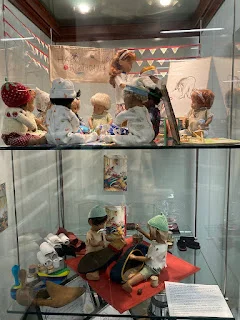 |
| The 2026 literary festival display |
Party games with a literary link
The upper shelf brings together two games. In “Pin the tail on the donkey,” Eeyore takes the donkey’s place, with baby Amy and other dolls gathered around the familiar challenge. The idea connects to a family Dress a Sasha entry from the 2017 Sasha Doll Festival in Washington DC, created by the collector’s younger daughter.
That earlier entry also gives the scene a timely connection: 2026 marks 100 years since the publication of Winnie-the-Pooh. A short story first appeared in a newspaper on 24 December 1925, followed by the book in 1926. For the 2017 outfits, Winnie-the-Pooh characters based on Ernest Shepard’s designs were redrawn by the daughter and printed on fabric by the collector’s sister’s company. Those details also helped shape clues for this year’s trail.
Alongside Eeyore’s game, all the family’s Sasha babies join in “Pass the Parcel.” Crumpled wrapping paper and the dolls’ different poses give the scene its sense of lively anticipation. Nine babies are shown playing, while Amy appears in the Eeyore scene. The cabinet also reuses the Happy Birthday banner made for the 2017 entry, set against Stony in Bloom bunting carried over from the Christmas arrangement.
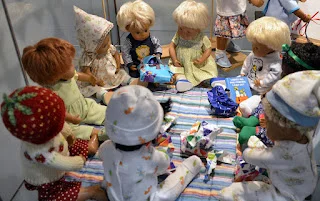 |
| Pass the Parcel being eagerly played by 9 Sasha babies |
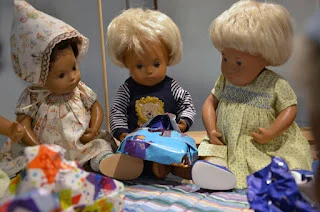 |
| Mabel, Leo and Daisy playing Pass the Parcel |
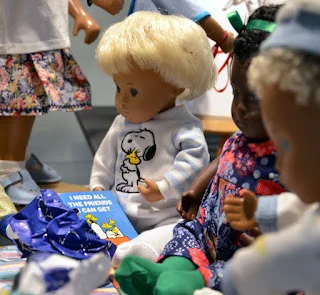 |
| Theo with a book while playing Pass the parcel beside babies Nina and Davy (who had a quick change after the Christmas display) |
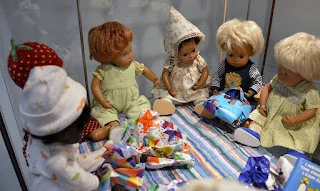 |
| L-R: Nomalizo, Ebony, Robin, Mabel, Leo and Daisy playing Pass the Parcel |
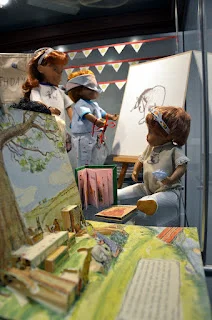 |
| Pin the tail on the donkey |
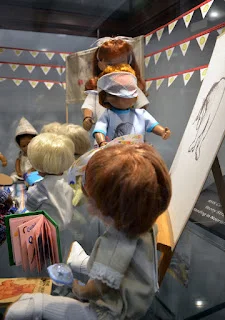 |
| Back view of baby Amy playing with her rattle and books |
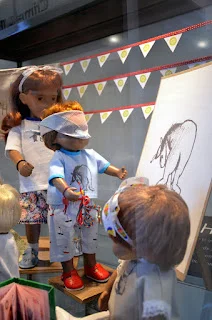 |
| Laura guiding Edmund as he tries to pin the tail on Eeyore |
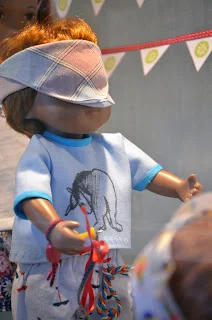 |
| Edmund wearing his Eeyore shirt and the blindfold while holding the tail |
A pop-up book adds another small-scale scene at the cabinet’s front corner. A library staff member suggested opening the book about Eeyore’s tail; placing it beneath the birthday banner would have hidden it. The open spread shows Christopher Robin pinning Eeyore’s tail back on, watched by Winnie-the-Pooh and Piglet.
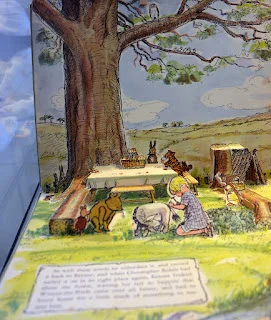 |
| The pop-up book open for the pin the tail scene |
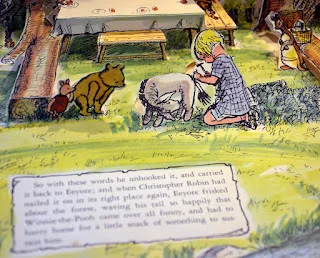 |
| Christopher Robin pins the tail back on Eeyore while Winnie-the-Pooh and Piglet watch |
Gregor elves and a handmade miniature workshop
The second shelf takes its cue from the 1965 Ladybird edition of The Elves and the Shoemaker, chosen by the library manager. Its painted illustrations inspired the collector to recreate a scene with two Sasha Morgenthaler Gregor dolls, Nicholas James and Trendon Elliott. Getting the shoes close to the book’s design took the most hands-on work.
An online search turned up no ready-made pair that suited the scene. A visit to Kingsman Gentleman Cobblers, a local shoe-repair and key-cutting shop, led to a practical suggestion: find second-hand pumps and paint them. The shop also lent vintage wooden shoe lasts, including one painted in bright stripes. Charity shops supplied pumps in a suitable style; their heels were built up with three shaped layers of thick card before acrylic paint was applied.
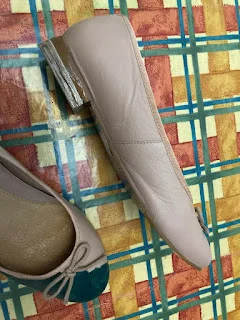 |
| The heels built up with thick cardboard glued on, and starting to paint |
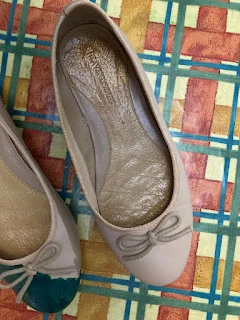 |
| Starting to paint the green |
Details help the pumps read as storybook props rather than modern shoes. The insides were painted, and size markings on the soles covered. On one heel, painted nail heads and a real panel pin suggest a nail being hammered in. For the shoe with yellow braid, thick thread runs from inside to outside; a large darning needle threaded onto it gives the sewing elf something to hold.
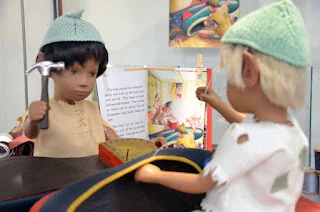 |
| Close up of the elves hammering and sewing the shoes |
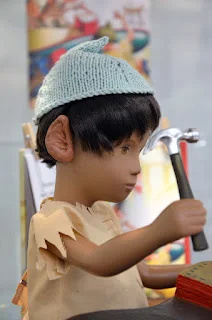
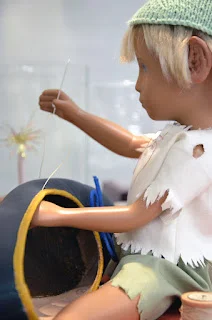
The elves’ clothes were made from stash fabric selected for its rustic appearance and approximate match to the book’s colours. One outfit uses cream where a faded yellow wasn’t available. To suggest wear, the garment edges were left unhemmed and snipped into jagged shapes; two patches and a shoulder hole echo the illustration. Knitted pointed caps and small Milliput ears complete the transformation. The ears were shaped over the dolls’ own ears, painted when dry and attached with tiny spots of tacky glue.
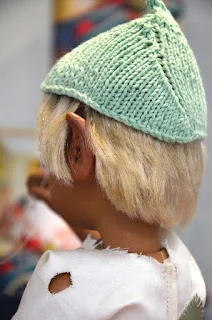 |
| close up of elf ear worn by Trendon Elliott |
 |
| close up of elf ear worn by Nicholas James |
 |
| Trendon Elliott sewing the braid on the shoe |
Small accessories fill out the workshop. The hammer is an Our Generation doll accessory with its handle painted to resemble wood. A miniature pointer was formed from leftover Milliput, with a needle set into it before the material dried. The candle holder combines a metal button with painted Milliput and sits on a wood stump. Tinsel clippings form the flame; the collector’s elder daughter joked that it looks ready to burst.
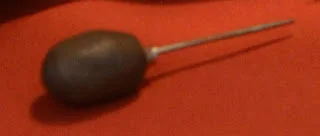 |
| the miniature pointer |
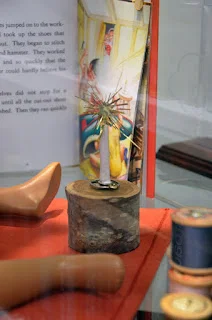 |
| The candle and candle stick on the stump of wood |
Leather scraps in several colours and thicknesses, vintage wooden cotton reels and shoe-polish brushes create the surrounding cobbler’s workspace. The borrowed lasts sit beside the dolls, while the Ladybird book is propped open at its illustration of the elves making shoes. Copies of the picture and book help show the shoemaker and his wife peering through curtains. A larger painted backdrop would have expanded the scene, but time was short and the Stony in Bloom trophies behind the glass shelf needed to remain visible.
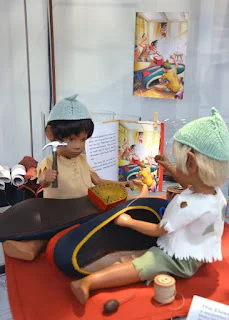 |
| Nicholas James being an Elf with a hammer while Trendon Elliott is the elf with the needle and thread |
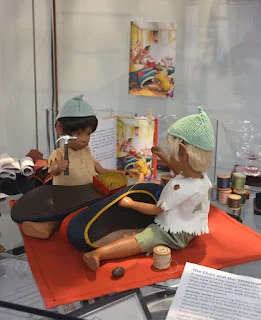 |
| The Elves and the Shoemaker display, showing the pointer in the foreground |
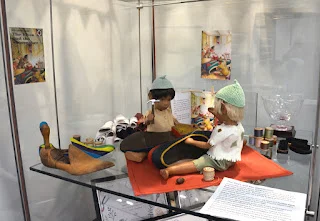 |
| The Elves and the Shoemaker display including the vintage lasts on loan from Kingsman Gentlemen Cobblers |
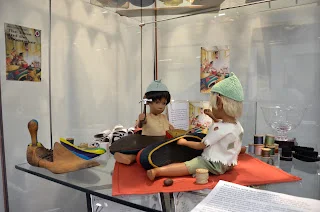 |
| The Elves and the Shoemaker display |
A trail that carries the story upstairs
Setting the cabinet took about 90 minutes. Four dolls from the Christmas display—Laura, Edmund, Davy and Nina—changed clothes at the library to join the party games; the other four returned home. The two scenes share the space with the Stony in Bloom trophies, and the party shelf is deliberately busy, with every baby included across the games.
Information about the displays was put on the wall beside the cabinet. The children’s trail runs along downstairs walls and windows, using short clue cards and directing participants upstairs to see the finished display. Its wording was made simpler and shorter than the previous year’s trail, which had proved too wordy for very young readers.
The library manager liked how the clues connect the traditional games with the fairy story through the theme of giving and receiving. Families have been taking part, and each completed answer sheet earns a shoe or boot template designed by the collector. Library staff are encouraging children to decorate their templates and bring them back for a library display. That invitation extends the cabinet’s handmade spirit beyond the glass: the next part of the scene may come from the young visitors themselves.
Read about the earlier Sasha Exhibition for the local library, the Christmas display, and the 2017 Dress a Sasha entry at the Sasha Doll Festival in Washington DC.