Fair Rosamund Recreated for the 2024 Dress a Sasha Festival
- Project
- Toys & Action Figures
- Drawn by
- [email protected] (DollMum)
- Issued
- Sheet
- A-160
A painstaking doll scale tribute to Arthur Hughes’s 1854 painting brought together fitted sewing, embroidery and a hand built garden scene.

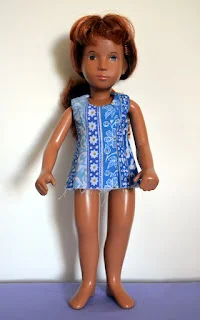
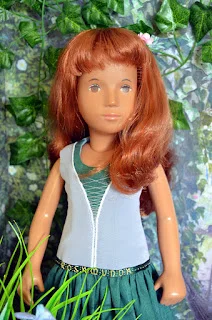
A miniature dress can carry an entire painting’s story. For the 2024 Dress a Sasha competition in Milton Keynes, DollMum’s younger daughter chose Arthur Hughes’s 1854 painting Fair Rosamund as the model for an English Garden Created by Adult entry. Her Sasha White Dress doll Laura, with long auburn hair, became the central figure in a detailed garden scene shaped by careful sewing, painting and collage.
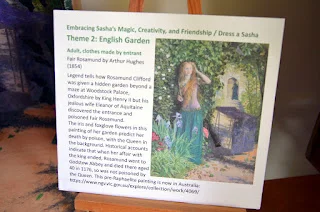
The choice reflected both the composition and the legend behind the painting. Rosamund Clifford is said to have lived in a hidden garden beyond a maze at Woodstock Palace, Oxfordshire, where King Henry II kept her. The story claims that Eleanor of Aquitaine found the entrance and poisoned Rosamund. Iris and foxglove in Hughes’s painting foreshadow that ending, while the Queen appears in the background. The description card for the display also points out that historical accounts say Rosamund went to Godstow Abbey after her relationship with the king ended and died there aged 40 in 1176, rather than being poisoned.
That mix of romantic imagery and a darker tale appealed to the young maker, who enjoys Goth and steampunk influenced clothing. She searched online for a Pre-Raphaelite garden scene that could be adapted to doll scale, then settled on Hughes’s painting. Her mother was entering the same competition category, but the project became a shared exchange of ideas rather than a contest between them.
Fitting the dress to Laura
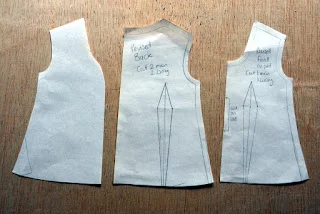
The dress demanded a new pattern. An earlier Sasha dress bodice pattern was too short and not close fitting enough to reproduce Rosamund’s shape, so the daughter redrew it and tested the first version in leftover skirt fabric. That prototype didn’t meet her expectations. She revised the pattern again, then positioned and machine stitched darts in both the white lining and the main fabric before assembling the bodice.
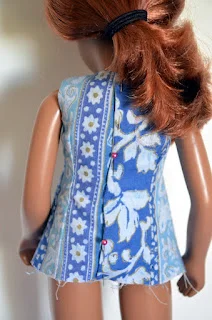
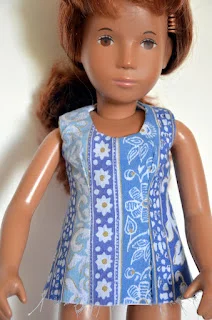
The gauze overlay presented a separate problem: its edges frayed too easily to roll and stitch by hand. Advice from a staff member at a local sewing shop pointed her toward the rolled edge stitch on an overlocker. It solved the issue, though assembling the overlay with the other bodice pieces still called for precise handling. Rather than make the gauze into a separate bodice, she captured its seams inside the construction. The overlay had no darts, so its extra fabric above the waist was trimmed at the side seams and allowed to stretch gently over the fitted bodice.
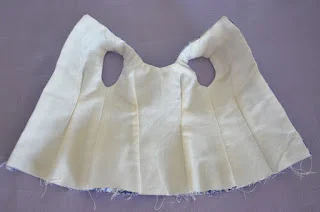
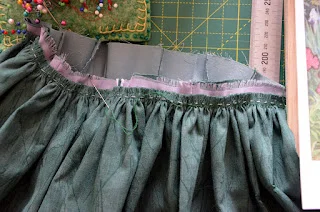
Laura modelled the second bodice prototype while it was pinned in place, giving the maker a chance to check the fit and shape before cutting the chosen fabrics. Once assembled, the bodice was joined to a double gathered skirt. She hand stitched around each gather, adjusted the skirt until it hung as intended, then attached the lining with small, neat stitches. A hand sewn hem caught only a thread on the inside of the skirt, keeping the stitches nearly invisible from the front.
Small details carry the design
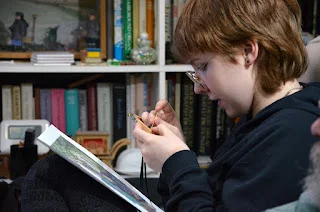
The waistband brought the painting’s lettering into the costume. The maker stretched a 7mm wide dark green satin ribbon in a small embroidery hoop and used golden yellow floss to embroider Rosamund’s name. To set the scale, she drew a reduced copy of the lettering from the painting on paper. She unpicked stitches when they fell short of the finish she wanted, making the embroidery one of the details she took particular care over.
Snap fasteners, also called press studs, close the back of the dress. Most were sewn on before the waistband was attached; the final pair went in line with the band. The back of the full skirt was left unjoined because the display would conceal the opening, and the edges didn’t need hemming because the skirt was cut across the full width of the fabric to create generous gathers.
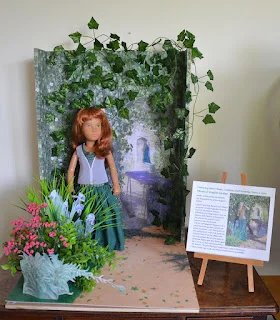
On Thursday morning, just before the festival, she dressed Laura and added the last detail: fine criss-cross lacing across the gauze bodice. Using a single cotton thread, she stitched the lacing from the waist upward while the dress was on the doll, allowing her to set the tension against Laura’s shape.
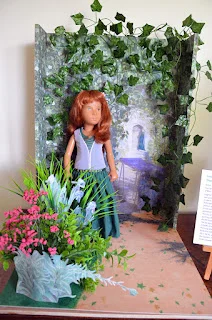
Building the garden around the doll
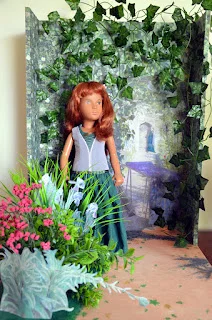
The scene’s base and backdrop were made from plywood boards cut to size by a local timber merchant. The maker’s father made brass brackets, secured with round head brass screws, to join the boards. The same construction method was used for her mother’s display base.
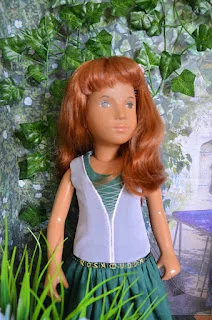
For the backdrop, the daughter printed an enlarged version of the painting at a scale that suited the doll, then glued part of its background onto thick card. Since the image didn’t cover the whole card, she filled the remaining areas on the back and sides with paper cutouts of leaves and flowers from the painting. The collage took several hours of careful work. When a cheap replacement glue stick proved inadequate, her mother made a quick trip to a local shop for the right adhesive.
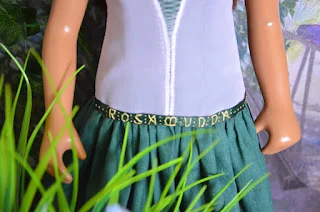
She painted the baseboard’s thick card with acrylics, mixing colours to suggest the painting’s mottled path. Painted fallen leaves and extended shadows helped connect the path to the background. The work also gave her a chance to return to painting after last doing art for GCSE about five years earlier.
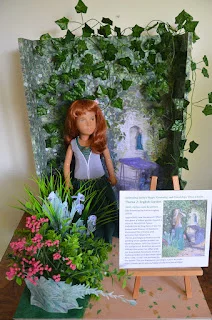
The competition rules asked entrants to use as many recycled materials as possible. Some elements came from supplies already on hand: green oasis blocks left from a craft workshop six years earlier became supports for foreground plants, and cutouts from the enlarged painting added flowers and foliage. Small scale imitation ivy strands and plastic flowers were bought locally because making those details by hand wasn’t practical within the available time. Arranged across the base, they built up the garden foreground.
A miniature easel suited the display’s source material. The description card, mounted on thick card, identifies Fair Rosamund by Arthur Hughes (1854), recounts the legend and distinguishes it from the historical account of Rosamund’s final years. It also notes that the painting is now in Australia and links to its collection page at the National Gallery of Victoria.
Photographs of the finished entry show Laura in the completed garden, along with close views of the embroidered waistband, fine bodice lacing, foreground planting and information card. The patient work across the dress and display turned a painting into a doll scale scene, and the daughter was already looking forward to finding another creative project after the festival.
| Rev | Description | Date |
|---|---|---|
| A | Issued for reading | |
| B | Viewed 498 times | Current |