1952–53 Matsuo Baseball Card: Takeshi Nomura and a Changing Prize Offer
- Project
- LEGO & Building Sets
- Drawn by
- [email protected] (Unknown)
- Issued
- Sheet
- A-177
A scarce Matsuo-era baseball card pairs Mainichi Orions pitcher Takeshi Nomura with a redemption offer that changed during the promotion.

The appeal of this early baseball card lies in the details on both sides: its connection to pitcher Takeshi Nomura and a redemption offer whose prize list appears to have changed while the cards were in circulation. Produced in 1952 or 1953, it comes from a small group of baseball card sets distributed with snack products by a company that had not yet adopted the Calbee name.
Matsuo, Calbee and the card’s date
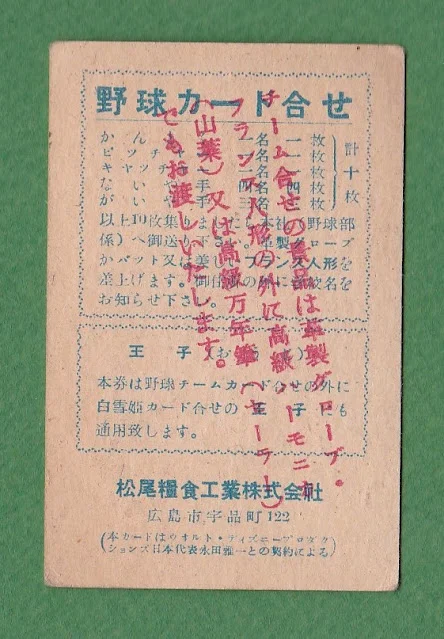
The company identified on the backs was Matsuo Ryoshoku Kogyou Corporation, or Matsuo Food Industry Corporation. “Calbee,” which appears on some cards, was then the name of a Matsuo product rather than the company itself. Matsuo changed its corporate name to Calbee in 1955, a couple of years after these cards were made.
The Engel guide’s note for set JF62a says the name change apparently happened around the time the cards were produced. That’s close in spirit but not quite right on the timing: the cards belong to the Matsuo period, while the company name changed in 1955. The distinction matters for collectors trying to place these sets in the maker’s history. A Calbee product name on an early card doesn’t mean the card was issued by a company already called Calbee.
Cards from this period are hard to find and appear only occasionally at sale, including on Yahoo Auctions. The collector who wrote the original account had spent years trying to acquire one, repeatedly losing out when examples came up. This time, a bid on a card with a design that stood out from some of its plainer contemporaries finally secured the piece.
A card featuring Takeshi Nomura
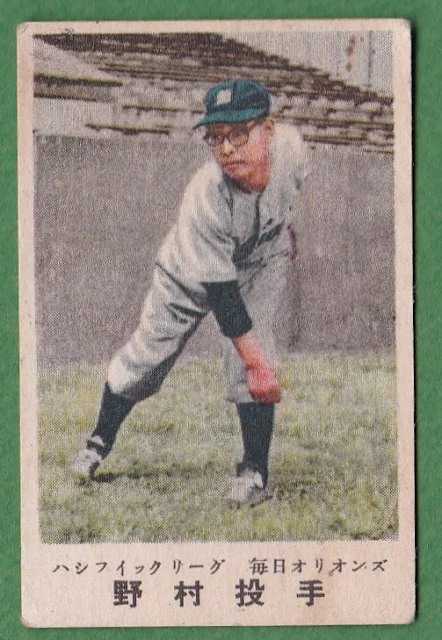
The subject is Mainichi Orions pitcher Takeshi Nomura. Engel lists him as Kiyoshi Nomura, while the Japanese Wikipedia page cited by the collector gives his name as Takeshi. The account suggests he was recorded as Kiyoshi when he joined the Senators in 1946, then changed his name to Takeshi after that season. On that reading, Takeshi is the name he would have used when the card was issued.
Nomura’s career record has an unusual symmetry: 73 wins and 73 losses. Most of those decisions came between 1950 and 1956, alongside a few games in 1946. His strongest stretch came early in that run. In 1950, he went 18–4 and was a prominent starter for the Orions from 1950 through 1952. His performance declined relatively quickly after that peak, which places the card in the period when he was still among the club’s stronger starters.
That context gives the card a particular appeal beyond its scarcity. It captures a player during the stretch that defined the best part of his career, while preserving a period detail that can be easy to miss: even Nomura’s given name appears differently across references. Collectors comparing catalogue entries with the card itself may find that discrepancy useful when checking how the player is identified.
Reading the redemption text
The back offers another small piece of the set’s history. Blue text describes a redemption that required a specific group of 10 cards: one manager, one pitcher, one catcher, four infielders and three outfielders. Send in the completed combination, the text says, and the company would provide a prize: a glove, a bat or a French doll.
Red text on the same back appears to revise those choices. It lists a glove, a French doll, a harmonica or a fountain pen, with the bat no longer included. The original account suggests Matsuo may have run out of bats and replaced them with other available goods. The printed text establishes that the prize choices differ; it doesn’t explain why the offer changed or when the revised terms took effect.
For collectors, that difference makes the reverse worth examining as closely as the front. The two colors preserve distinct versions of the redemption offer on a single card, turning ordinary promotional copy into evidence of how the offer was presented. Any interpretation of the reason for the change remains a guess unless further documentation surfaces.
Design and collecting appeal
Some Matsuo-era sets are visually plain, with promotional advertising taking up much of the front. The account singles out sets JF63a and JF63b as examples. This Nomura card made a stronger impression on its collector, who liked its appearance enough to place a serious bid after years of coming away empty-handed.
That combination of a distinctive front, a scarce issue, a player from the early 1950s and a back printed with changing prize terms makes the card rewarding to study. Its clearest clues are also its most useful: the Matsuo company name anchors the corporate timeline, the player details connect it to Nomura’s peak years, and the colored redemption text records two different prize lists. Those are the details to compare when another example appears for sale.
| Rev | Description | Date |
|---|---|---|
| A | Issued for reading | |
| B | Viewed 969 times | Current |