The Chateau Folly Room Box: A Finished Miniature Interior with a Handmade Chandelier
- Project
- LEGO & Building Sets
- Drawn by
- Jennifer
- Issued
- Sheet
- A-18
A completed Chateau / Folly room box pairs a simple LED setup with a gold-leafed, 3D-printed chandelier and a well-timed vintage settee find.
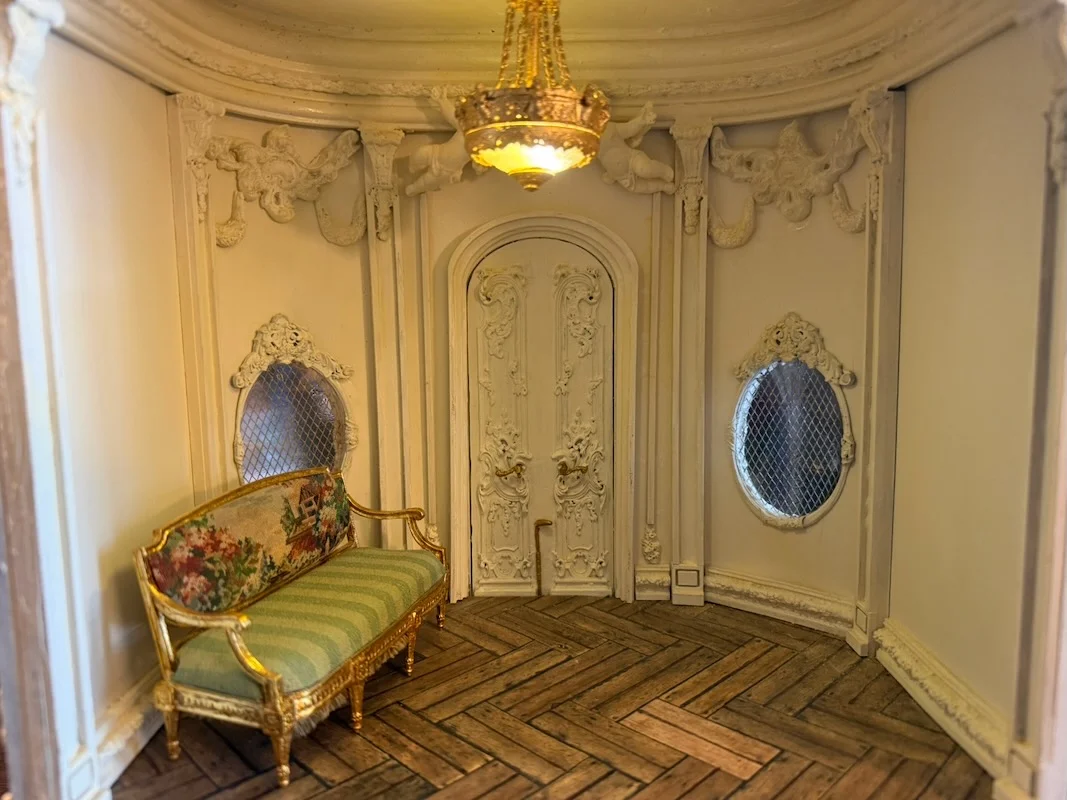
The Chateau / Folly room box is essentially finished, and its most telling details are the ones that make the miniature feel like a carefully assembled place: a chandelier built from printed parts, fine chains hung by hand, and a lower door concealing most of the electrical setup. The maker plans to add a few more objects, but the room is already on display at home.
Exterior and interior views
The exterior offers the first view of the completed piece, while the interior photographs show the room from several angles. Together, the images give a sense of the project as a finished display object, with the interior’s details carrying much of its character.

The interior is at the point where the larger elements have found their places. A room box can change considerably as furnishings and lighting come together: an item that seemed uncertain on its own may prove right once the surrounding space is complete. That happened here with the settee, which the maker had bought from June at a show a few years earlier. Only after finishing the interior did it become clear how naturally it would suit the room.


Lighting kept simple and tucked away
A lower door hides the electrical components, leaving the lead wire as the visible connection to the outside. The lighting itself uses a straightforward arrangement: one line with a switch powers an LED in the chandelier, and the line runs to a transformer that plugs into a wall outlet. The design keeps the working parts accessible behind the door while allowing the chandelier to serve as the room’s lit focal point.
For miniature displays, this kind of simple layout can make practical sense. The light needs a power source, a way to turn it on and off, and a route for its wiring. Hiding those parts behind a movable panel helps the room read as a finished scene while keeping the setup usable. Here, the maker describes exactly where the wire remains visible, so the concealment is partial rather than complete.
A chandelier assembled piece by piece
The chandelier began with 3D printing, but the printed form was only the starting point. The maker applied gold leaf, glued the components together, then attached the small chains to tiny hooks. That final step called for patient handwork, with round-nose pliers and thin needle-nose pliers proving especially useful for handling the small fittings.
The combination of printed parts and hand finishing gives the fixture a distinct place in the project. Printing can establish a repeatable base shape; gilding, assembly and chain placement add the surface finish and fine details that draw the eye at room scale. Working with tiny hooks and links also shows how much of a miniature’s finish depends on control and suitable tools. The maker’s thanks to those pliers sounds well earned.

A found furnishing that fit the finished room
The settee’s story is a useful reminder that a miniature interior can come together through a mix of planned work and fortunate discoveries. It came from June at a show several years before the room was complete. Its eventual place wasn’t apparent until the maker had finished the rest of the interior and could judge how the piece worked within the whole setting.
That approach leaves room for a collection to shape a project over time. A furnishing acquired earlier can wait until a suitable scene emerges, and the completed room can help reveal which pieces belong. The maker expects to add a few more bits and pieces, so the display may continue to develop. For now, the Chateau / Folly room box is essentially complete and has moved from the workbench to a place on display in the maker’s home.
| Rev | Description | Date |
|---|---|---|
| A | Issued for reading | |
| B | Viewed 720 times | Current |