Martha Boers’ Armoured Dolls Bring a Storybook Scene to Life
- Project
- Toys & Action Figures
- Drawn by
- James Davis
- Issued
- Sheet
- A-192
Canadian doll artist Martha Boers pairs ball-jointed and artist dolls with flowing capes, arched settings and imagined stories.
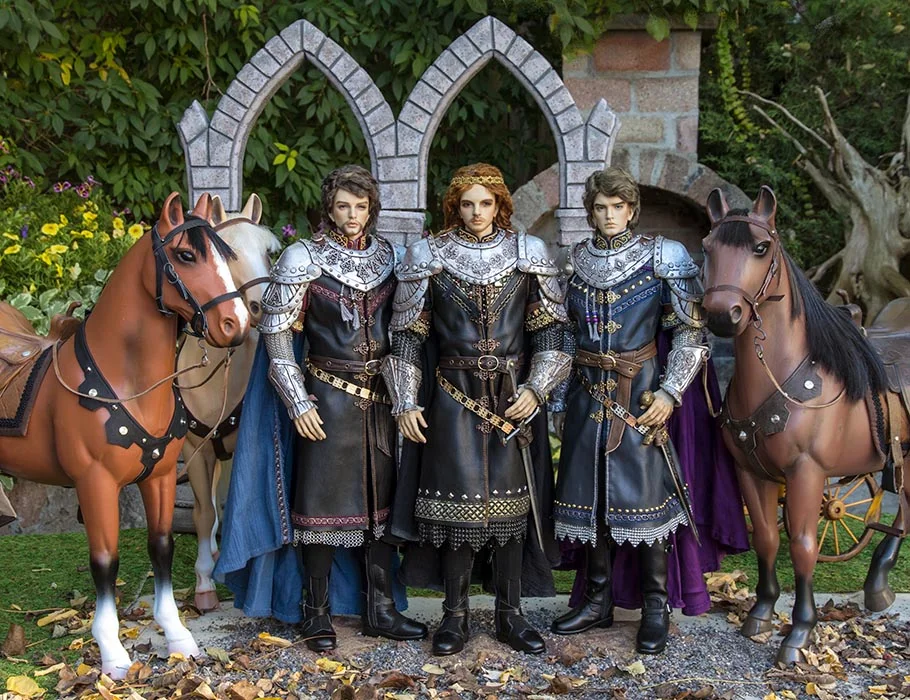
The appeal of Martha Boers’ armoured dolls lies in the scene as much as in the figures themselves: capes trail behind them, while arches suggest the grounds of an imagined kingdom. That combination gives the display a sense of movement and place, turning a group of posed dolls into a moment from a story.
Costume, pose and setting work together
A cape can change the whole silhouette of an armoured figure. Its line draws the eye beyond the body and gives a static pose an impression of motion. In Boers’ scenes, the garments are part of the visual composition: they frame the figures and help convey the character’s presence. The original description calls them capes with a touch of uncertainty, but the effect is clear—the fabric is a defining part of the look.
The arches provide a second strong visual cue. Set behind the figures, they suggest architectural grounds and give the portraits depth. Their shape creates a frame within the image, directing attention back to the dolls while hinting at a larger setting beyond the crop. The result feels theatrical without requiring a detailed account of the setting; a few carefully chosen elements are enough to prompt the viewer to imagine the rest.
That balance is one of the pleasures of doll photography. A figure’s costume and pose can carry the character, while the background supplies atmosphere. When those elements support one another, the image reads as a small narrative rather than a record of an object on display. Boers’ fondness for flowing capes and arched surroundings points to that storytelling approach.
A collection shaped by storytelling
Martha Boers is an award-winning Canadian doll artist and costumer. She also photographs her collection and develops stories featuring her ball-jointed and artist dolls. Those interests meet in the armoured figures: costuming gives them a distinctive appearance, photography preserves the chosen arrangement, and narrative imagination gives the scene its implied world.
Ball-jointed and artist dolls offer a broad canvas for this kind of work. Their appeal in a staged image comes from the way a collector can bring together pose, clothing and surroundings to suggest personality. The source gives no maker, model, scale or date for the figures shown, so the strongest details here are the visual ones: armour, flowing capes and arches that evoke a royal setting. The absence of production specifics makes the presentation feel centered on the composition and the artist’s interpretation.
For collectors, photographs like these also show how presentation can shape the experience of a collection. A doll viewed alone invites attention to its sculpt and costume; a doll placed in a scene encourages the viewer to consider character and context. Neither approach replaces the other. Here, the staged setting gives the figures a storybook quality while leaving their costumes as the main attraction.
Following the artist’s work
Boers’ work sits at the meeting point of collecting and making. The dolls are collected objects, while the clothing, arrangement and photographic choices express an individual creative perspective. That makes the images useful to readers interested in doll costuming as well as to those who enjoy artist dolls for their sculpted presence and expressive posing.
The scene also leaves room for interpretation. The arches might belong to a castle, a courtyard or another imagined royal space; the source identifies them only as arches on the grounds of a kingdom. Keeping that setting open is part of the charm. Viewers can supply their own story, guided by the figures’ armour and the sweep of their capes.
Readers can follow the related feature through the linked “Read More” page. The original page also lists an email contact for Boers. Together, the images and artist profile offer a glimpse of a collection approached with a costumer’s eye and a storyteller’s instinct. The enduring draw is that small shift from seeing a doll posed to imagining the scene continuing just beyond the frame.
| Rev | Description | Date |
|---|---|---|
| A | Issued for reading | |
| B | Viewed 733 times | Current |