Martha Boers’ Ball-Jointed Dragons Settle In for a Bedtime Scene
- Project
- Toys & Action Figures
- Drawn by
- Michael Garcia
- Issued
- Sheet
- A-196
Doll artist Martha Boers brings a gentle family story to life, with little dragons tucked into bed beside their stuffed companions.
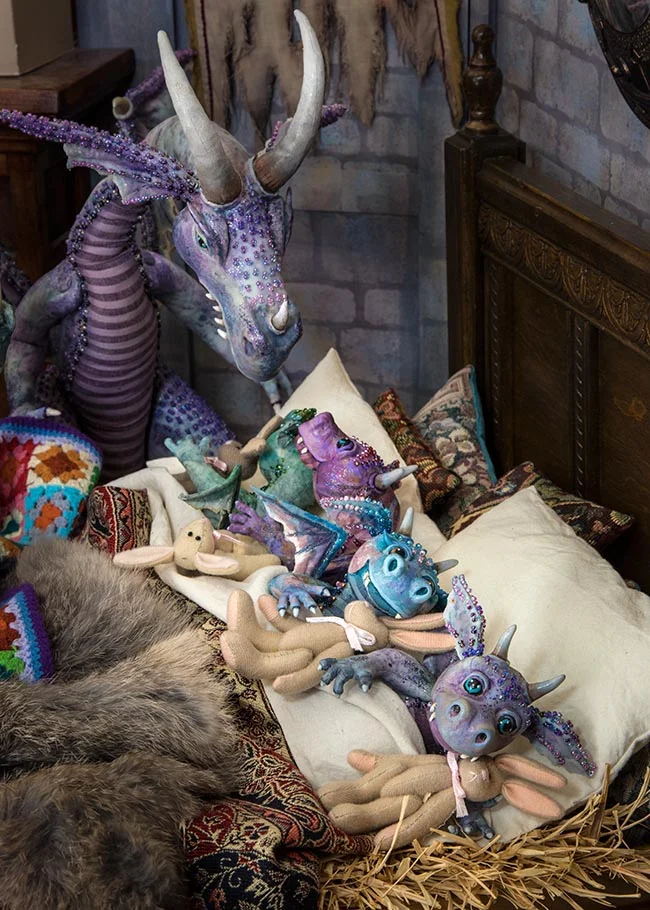
A quiet bedtime scene gives Martha Boers’ little dragons an unexpectedly human warmth. Settled beside their stuffed companions, the figures look peaceful and angelic; the imagined story behind the image suggests a family home again after a lovely vacation. That small narrative turn is what makes the display linger: these aren’t simply dolls arranged for a portrait, but characters with a shared life beyond the frame. The scene asks little of the viewer, yet it gives the imagination a clear place to begin.
A domestic moment for fantastical figures
The dragons’ calm posture and bedtime setting soften their fantasy features. Their stuffies add a familiar note, while the tucked-in arrangement invites viewers to picture the end of a busy day. The scene leaves room for the audience to supply its own details: perhaps the family has returned from a trip, and Mama and Papa can finally relax now that everyone is home safe and sound. That imagined return gives the still image a before and after, even though only one moment is shown.
That reading comes from the scene’s gentle mood rather than an elaborate plot. The figures’ expressions, placement and accessories do the storytelling. A bed and a few small companions are enough to suggest care, routine and the comfort of being together. For collectors, that kind of staging shows how a doll display can create a sense of character without relying on a large set or a complicated backdrop. The restraint is part of the effect: viewers notice the relationships because there’s little competing for attention.
Domestic scenes also give fantastical figures a useful point of connection. Dragons may be unusual subjects, but rest, family and bedtime rituals are easy to recognize. Here’s the thing: the contrast doesn’t need to be explained. The dragons’ imaginative design draws the eye, while their familiar surroundings make the scene feel emotionally legible.
Storytelling through dolls and photography
Boers is an award-winning Canadian doll artist and costumer. She also photographs her collection and develops stories featuring ball-jointed and artist dolls. Those interests meet in scenes like this one: costume and pose establish the figures’ personalities, while the photograph preserves a carefully arranged moment as a self-contained story. A viewer can encounter the image without knowing a longer fictional history and still understand its quiet mood.
Ball-jointed dolls offer artists a practical range of poses, making small gestures especially useful in a scene built around rest and affection. A slight change in head angle, the way a hand rests near a stuffie, or the spacing between figures can shift the mood. Costuming adds another layer, helping a character feel at home in a particular setting. The source doesn’t identify the dragons’ makers, editions, materials or measurements, so the scene’s appeal rests on its presentation and the story viewers read into it. That limit matters: the image supports an interpretation of character, but it doesn’t establish the dolls’ production history.
Photography matters because the viewer encounters the arrangement through a single chosen frame. The artist decides what enters the picture and what stays outside it: the dolls’ positions, their companions, the bedding and the visual distance between characters. In a bedtime portrait, a close, settled composition can make the figures feel protected and at ease. The photograph then becomes a record of the artist’s staging, even as the imagined story continues in the viewer’s mind.
There’s also a practical discipline behind a convincing photograph of a small display. Each element has to read clearly at the scale of the image, and the arrangement has to hold attention without feeling stiff. A prop can suggest a relationship, but too many details may distract from the figures themselves (and this is the part most people overlook). The image’s quietness, then, is an artistic choice as much as a mood.
Why the scene connects
The comments accompanying the image focus on that emotional effect. One viewer sees little angels and imagines relieved parents welcoming the family home after a vacation. Another praises how “human” the dragons feel, especially as they rest with their stuffies. The responses point to a central pleasure of character-doll collecting: the figures can be fantastical in design yet recognizable in their gestures and relationships. Their appeal comes through the interaction between what the dolls are and what they appear to be doing.
That balance gives the display its charm. The dragons remain dragons, but the bedtime ritual is instantly familiar. Their stuffed companions make the scale and setting feel personal, and the peaceful pose gives the scene a clear ending for the day. It’s a tender example of how collectors and artists can use dolls to suggest an entire world through one quiet moment. The numbers here are underwhelming in the best sense: there’s no crowd of props or elaborate scenery competing with the central idea.
What a quiet display can do
This is more significant than it looks. A simple arrangement can make a collection feel inhabited, giving individual figures relationships and routines that extend beyond their display space. That can change how viewers respond: instead of assessing only a doll’s sculpt or costume, they begin to read the scene as a moment in a continuing story. If you’re working in this space, the example is a reminder that a small, specific gesture can carry more narrative weight than a set filled with explanation.
And yet, the scene leaves its story open. The vacation is an interpretation offered by a viewer, not a documented part of the image’s backstory. That openness gives other viewers room to imagine their own version of the family’s day. A single frame, a shared bed, a few stuffies. Enough.
For more of Boers’ work, the source points readers to a feature on Martha Boers and “Antique Lilac”. Here, the lasting detail is simpler: a family of little dragons, safe at home, settling in for the night. The scene’s future life is in the looking; each viewer can carry its small story away with them.
| Rev | Description | Date |
|---|---|---|
| A | Issued for reading | |
| B | Viewed 517 times | Current |