20 Football Cards Trace African American Trailblazers’ Firsts
- Project
- Stamps & Postal History
- Drawn by
- aaronmpowell
- Issued
- Sheet
- A-199
A 20-card run follows African American football pioneers from the NFL’s 1946 return to the game’s biggest leadership barriers.
Twenty football cards preserve a history that’s still less familiar than baseball’s: African American players who opened doors on the field and, later, in the sport’s leadership. The run spans 1948 Leaf through 1985 Topps, pairing each card with a first or barrier its subject helped break. Its collector’s appeal lies in that connection between a piece of cardboard and a story worth knowing.

The idea grew from a collection of 87 Negro League players who also appeared in the major leagues. A 2021 series by Joe Genovese on the SABR Baseball Cards blog explored a similar collecting approach: “From the Negro League to MLB”. This football run follows the same principle, with one important limit: a player must have broken a significant barrier in professional football and have a card issued during his playing career. The cards are generally recognized rookie cards, although some are not.
That rule leaves out early Black professionals who played before World War II. Charles Follis was paid to play in 1904; Fritz Pollard played for and co-coached Akron in 1921; and Duke Slater, Bobby Marshall, Joe Lillard and Ray Kemp also played in the NFL. The league’s exclusion of Black players began after the 1933 season, and no known card issued during those early players’ careers meets the run’s criteria.
Football’s return to integration
Four players crossed the barrier in 1946. Kenny Washington signed with the Rams on March 21, the first Black player signed by an NFL club since the exclusion began. Woody Strode joined the Rams on May 7. That year, Bill Willis and Marion Motley signed with the Cleveland Browns of the newly formed All-America Football Conference (AAFC). Since the AAFC season began first, Willis and Motley played before Washington and Strode. All four broke through before Jackie Robinson signed with the Dodgers.
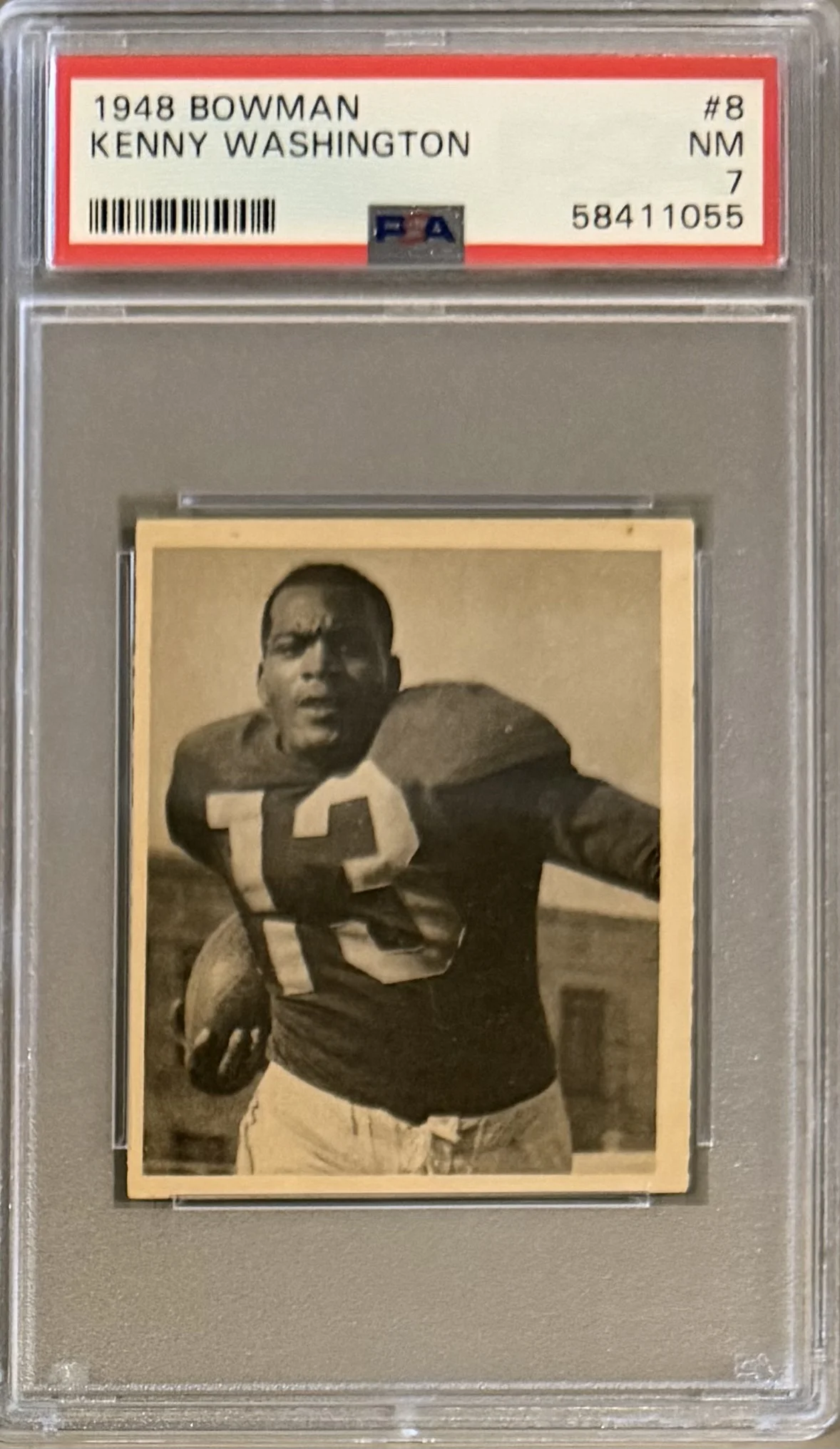
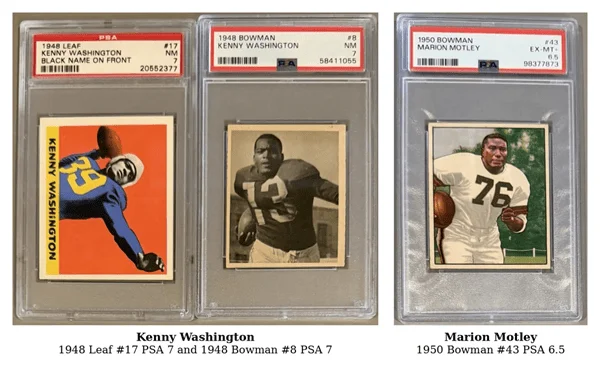
Washington’s story makes his two 1948 cards especially resonant. A multi-sport standout, he shared a UCLA football backfield with Robinson and became the first African American to play varsity baseball at the school. Some observers rated him a stronger baseball prospect than Robinson. By the time his 1948 Leaf and 1948 Bowman cards appeared, serious knee injuries had limited him; 1948 was his final season.
Motley is the only other member of the four represented here by a playing-days card. His 1950 Bowman captures a player whose professional achievements extended well beyond the initial breakthrough: he led the AAFC in rushing in 1948 and the NFL in 1950. He was also the first Black back to earn all-league honors in both leagues.
Willis, despite an eight-season career, seven first-team all-league selections and a place in Canton, never appeared on a card while playing. The same is true of Strode, who spent one season with the Rams and two with Calgary of the CFL, winning the 1948 Grey Cup. He later became an actor, best known for playing Draba in Spartacus.
Draft milestones, records and recognition
George Taliaferro became the first Black player selected in an NFL draft when the Bears chose him in 1949. He had already signed with the Los Angeles Dons of the AAFC and never played for Chicago. His card in the run is 1948 Leaf #20. Wally Triplett, selected by the Lions in the 19th round that same year, became the first Black draftee to appear in an NFL game. His 1950 Bowman #109 came in his second NFL season.
Tank Younger’s 1950 Bowman #15 marks another path into the league: he was the first NFL player from a historically Black college, having attended Grambling. His success with the Rams helped open opportunities for players from Grambling, Jackson State, Morgan State and Southern. Through the class of 2026, 36 of the Pro Football Hall of Fame’s 387 members had attended an HBCU. That group includes Walter Payton of Jackson State and Jerry Rice of Mississippi Valley State. Younger later broke another barrier, becoming the league’s first Black assistant general manager when the Chargers hired him in 1975.

Joe Perry’s 1950 Bowman #35 represents two milestones from 1954: he became the first Black player named NFL MVP and the first player of any race to rush for 1,000 yards in back-to-back seasons.

Emlen Tunnell’s 1951 Bowman #91 recalls a career packed with defensive distinctions. He was elected to the Hall of Fame in 1967, the first African American player to receive that recognition. Across 14 seasons, he made nine Pro Bowls, earned six first-team All-NFL selections and retired with a record 79 interceptions.
Bob Mann’s story runs through two franchises. He and Mel Groomes became the Lions’ first Black players in 1948. The following year, Mann led the NFL in receiving with 1,014 yards, the first Black player to top the league in that category. After the Lions asked him to accept a pay reduction from $7,500 to $6,000, he refused. Detroit sent him to the New York Yanks, who released him three weeks later. No other team signed him despite his record. Mann filed a collusion suit against the NFL; Green Bay signed him on November 25, 1950, bringing the suit to an end. He became the first Black player of the modern era with the Packers and, as far as the collector behind this run could determine, the only player to integrate two NFL franchises.
Bobby Mitchell’s 1959 Topps #140 marks the final team to accept a Black player. Washington added Mitchell in 1962, 16 years after the four players who reopened the NFL and AAFC.

Quarterbacks kept facing a separate barrier
Integration as a whole didn’t bring equal access to quarterback. Willie Thrower threw eight passes for the Bears in 1953, becoming the first Black quarterback in the modern NFL. In 1968, the Raiders selected Eldridge Dickey of Tennessee State in the first round, the first Black quarterback drafted that high. They moved him to receiver after he joined the team.
Marlin Briscoe became the first Black quarterback to start a modern-era game on October 6, 1968. He threw 14 touchdowns that season, setting a Broncos rookie record that stood until 2024. The following summer, told he wouldn’t start, Briscoe asked for his release. He never got another opportunity to play quarterback. His 1972 Topps #30 shows him as a Buffalo Bills receiver.
James Harris, a Grambling alumnus, became the first Black quarterback to start a season opener when he did so for Buffalo of the AFL in 1969. In 1974, with the Rams, he became the first to start and win a playoff game. His card is 1975 Topps #338.
Doug Williams, also from Grambling, went on to start a Super Bowl and lead Washington to victory, earning Super Bowl MVP. His 1979 Topps #48 is likely the card in this run most familiar to casual collectors. Warren Moon’s 1985 Topps #251 closes the quarterback group. Undrafted in 1978 because teams wanted him at other positions, he chose the CFL, joined Edmonton and won five straight Grey Cups. In 1984, he joined the Houston Oilers on his own terms. Earlier Canadian issues document his Edmonton seasons; the card here is his NFL rookie. In 2006, Moon became the first Black quarterback elected to the Hall of Fame. When the 2026 season opened, Black quarterbacks held 15 of the NFL’s 32 starting jobs.

Players who moved into leadership
The final group honors five players who broke barriers after their playing careers. Each is represented by a card issued while he was still playing. That shared pattern is striking: the men remembered here first built their standing on the field, then took on positions of influence.
Buddy Young, a 5-foot-4 halfback who played for the AAFC Yankees, the Dallas Texans and the Colts, appears on 1950 Bowman #123. In 1964, Pete Rozelle hired him as the first Black executive in a major league office. Two years later, Young sent Rozelle a five-page memo on the league’s treatment of Black players, urging every club to place at least one Black person in its front office. Rozelle forwarded it to all 15 teams. The Rooney Rule followed 37 years later.
Tank Younger earns a second mention in the leadership group for his 1975 appointment as the league’s first Black assistant general manager. Art Shell and Gene Upshaw, teammates on the Raiders’ offensive line, also made their marks beyond the field. Upshaw became executive director of the NFL Players Association in 1983, the first Black man to lead a major sports union. Shell became the first Black head coach of the modern era when Al Davis hired him in 1989. Their cards are 1972 Topps #186 and 1973 Topps #77, respectively.

Tony Dungy’s only playing-days card is 1979 Topps #19, a Steelers team leaders card shared with Franco Harris, L.C. Greenwood and Larry Anderson. Dungy led Pittsburgh with six interceptions in 1978. In 2007, he became the first Black head coach to win a Super Bowl, coaching against Lovie Smith in the final. Ozzie Newsome’s 1979 Topps #308 rookie completes the leadership group: the Ravens made him the first Black general manager in NFL history in 2002.
Two major barriers remain part of the run’s wider history: Black controlling ownership of an NFL franchise and the commissioner’s office. The cards don’t resolve those gaps, but they make the sequence of earlier breakthroughs visible.

The 20-card checklist
The grades below are part of the collection’s record, just like the card numbers and the milestones. The run includes duplicate subjects where different issues tell a fuller story: Washington appears twice, Mann twice, and Younger appears in both the on-field and leadership sections.
| # | Card | Grade | Milestone represented |
|---|---|---|---|
| 1 | 1948 Leaf #17 Kenny Washington | PSA 7 | Reintegrated the NFL, Rams, 1946 |
| 2 | 1948 Bowman #8 Kenny Washington | PSA 7 | Reintegrated the NFL, Rams, 1946 |
| 3 | 1948 Leaf #20 George Taliaferro | PSA 7 | First Black player drafted by an NFL club (1949) |
| 4 | 1948 Leaf #44 Bob Mann | PSA 6 | Integrated the Lions (1948) and Packers (1950); first Black player to lead the NFL in receiving (1949) |
| 5 | 1948 Bowman #47 Bob Mann | SGC 9 | Integrated the Lions (1948) and Packers (1950); first Black player to lead the NFL in receiving (1949) |
| 6 | 1950 Bowman #15 Tank Younger | PSA 8 | First NFL player from an HBCU (1949); first Black assistant GM (1975) |
| 7 | 1950 Bowman #35 Joe Perry | SGC 6 | First Black NFL MVP (1954) |
| 8 | 1950 Bowman #43 Marion Motley | PSA 6.5 | Reintegrated professional football with the Browns (1946); first Black back named all-league |
| 9 | 1950 Bowman #109 Wally Triplett | PSA 7 | First Black draftee to play in the NFL (1949) |
| 10 | 1950 Bowman #123 Buddy Young | PSA 7 | First Black executive in a major league office (1964) |
| 11 | 1951 Bowman #91 Emlen Tunnell | PSA 5 | First Black player elected to the Hall of Fame (1967) |
| 12 | 1959 Topps #140 Bobby Mitchell | PSA 8 | Integrated the last NFL holdout, Washington (1962) |
| 13 | 1972 Topps #30 Marlin Briscoe | PSA 8 | First Black starting quarterback of the modern era (1968) |
| 14 | 1972 Topps #186 Gene Upshaw | PSA 8 | First Black head of a major sports union (1983) |
| 15 | 1973 Topps #77 Art Shell | PSA 7 | First Black head coach of the modern era (1989) |
| 16 | 1975 Topps #338 James Harris | PSA 9 | First Black QB to start an opener (1969) and win a playoff game (1974) |
| 17 | 1979 Topps #19 Tony Dungy | PSA 8 | First Black head coach to win a Super Bowl (2007) |
| 18 | 1979 Topps #48 Doug Williams | PSA 9 | First Black QB to start and win a Super Bowl (1988) |
| 19 | 1979 Topps #308 Ozzie Newsome | PSA 8 | First Black general manager (2002) |
| 20 | 1985 Topps #251 Warren Moon | PSA 8 | First Black QB in the Hall of Fame (2006) |
The checklist’s value is historical rather than financial. These cards put names, dates and playing careers beside milestones that can otherwise fade into a short list of “firsts.” Kenny Washington in particular deserves a place in public memory alongside Jackie Robinson. For a deeper account of the Black quarterback’s history, SABR member Lou Moore’s book The Great Black Hope offers a related reading path. For collectors, the next step is simple: follow the names on the cards, and keep the milestones attached to them.
| Rev | Description | Date |
|---|---|---|
| A | Issued for reading | |
| B | Viewed 335 times | Current |