George H. Wilson’s 1907 Manitowoc Postcard Preserves a Rare Baseball Image
- Project
- Antiques & Vintage
- Drawn by
- aosvintage
- Issued
- Sheet
- A-201
A scarce real-photo postcard captures pitcher George H. Wilson late in his career, linking collectors to an early chapter of integrated baseball.

A team portrait from Manitowoc, Wisconsin, offers one of the rarest surviving glimpses of pitcher George H. Wilson. The 1907 real-photo postcard measures 3-3/8″ × 5-3/8″ and shows Wilson seated at the far left of the front row, the only African American player pictured. Its small details—a photographer’s imprint, a penciled caption and a sharply preserved image—give collectors more than a team lineup: they help place Wilson in the final years of his playing career.
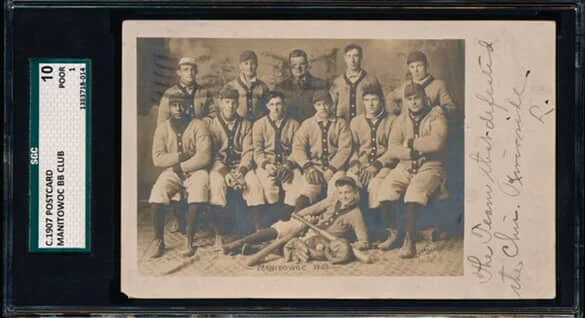
The caption identifies the team as “Manitowoc 1907.” The lower-right corner carries a faint “Melendy” imprint, while a penciled note along the card’s right edge reads, “The team that defeated Chi. Riverside.” The corners show some wear, but the photograph remains remarkably clear. That combination of readable image and surviving annotations makes the card especially useful to collectors trying to identify the players and understand the team’s local context.
The postcard belongs to a format whose popularity was taking off in 1907. Beginning in March of that year, the U.S. Post Office allowed privately produced postcards to carry a message on one side and the address on the other. The change helped launch the period commonly called the “Golden Age of Postcards.” Photographers could develop images directly from negatives onto postcard stock, producing real-photo cards for local buyers. Team portraits were among the subjects studios offered as souvenirs.
Two team portraits, one changing lineup
Manitowoc photographers Melendy and, later, Auermiller produced cards showing local baseball teams. A related 1908 portrait, credited to Auermiller, depicts many of the same players. Wilson appears in it too, this time standing at the far right of the back row. Seen together, the cards provide a small but valuable record of the team across two seasons, while also showing how a player’s position in a group photograph can help confirm identification.

The 1908 Auermiller portrait places Wilson in the back row, far right. For collectors, comparing this image with the 1907 Melendy card can help distinguish Wilson from teammates and track the changes in the pictured lineup.
Surviving examples of the 1907 card are scarce. Fewer than ten are known today, and four have been confirmed in public auction records. The surviving photographic record of Wilson is also unusually thin. His former teammate Honus Wagner appears in hundreds of known photographs and on dozens of cards; early players Chappie Johnson and Rube Foster are documented more extensively as well. Against that backdrop, even a single team portrait carries particular historical weight.

This close-up shows Wilson seated at the far left of the front row. The photograph preserves a clear likeness of the pitcher during his Manitowoc years.
Wilson’s career before Manitowoc
Wilson was born in Palmyra Township, Michigan, and earned the nickname “Palmyra Wonder” from his roots near Adrian. In 1895, at age 19, he pitched briefly for the Page Fence Giants before spending most of the season with the Adrian Demons, an integrated Michigan State League team. Honus Wagner was also on the Adrian roster. Wilson finished that season with a 29–4 pitching record and a .327 batting average, a remarkable start to a career that would take him across several prominent Black baseball teams.
After Adrian, Wilson returned to the Page Fence Giants and became one of the club’s leading pitchers through 1898. The team was a major force in Black baseball before disbanding that year. Wilson then helped form the Chicago Columbia Giants, pitching for the club from 1899 to 1900 and often working with catcher Chappie Johnson.
The Columbia Giants merged with Frank Leland’s Chicago Unions in 1901 to form the Chicago Union Giants. Wilson stayed with the new team until around 1905. Accounts described him as a hard-throwing left-hander; some called him “the swiftest pitcher in the country.” Those descriptions and his impressive early record help explain why the understated Manitowoc portrait matters: it shows a player whose career had already spanned leading teams and a rare international assignment.
A rare record of Wilson’s later seasons
During the winter of 1906–07, Wilson pitched for Habana in Cuba’s winter league. His 1907 box scores show a losing record, but playing abroad was unusual for an American player of the period. After returning, he joined semi-pro teams in the Upper Midwest. In 1907, he signed with a Manitowoc club in the Lake Shore League and remained there through the 1908 season—the stretch captured by the two team postcards.
Little is known about Wilson’s life after baseball. He died in November 1915, aged 40, at Kalamazoo State Hospital and was buried in Palmyra. His grave, beside those of family members, is among the few known markers of his legacy.
Hake’s Auctions described the 1907 card as “an early and historic item for Negro League collectors.” The card’s significance rests in its direct connection to Wilson and to a period when Black players appeared in some white-organized baseball settings before being excluded from them for decades. For collectors, its photographer’s credit, handwritten note, companion portrait and identifiable players all add to its interest. The surviving image lets Wilson’s Manitowoc season remain visible, and gives researchers a tangible starting point for piecing together a career that left few other photographs behind.
Share on X (Opens in new window)X Share on Facebook (Opens in new window)Facebook Email a link to a friend (Opens in new window)Email
| Rev | Description | Date |
|---|---|---|
| A | Issued for reading | |
| B | Viewed 392 times | Current |