Art Smith’s Modernist Jewelry: Sculptural Designs, History and Collecting Clues
- Project
- Coins & Currency
- Drawn by
- Pamela Siegel
- Issued
- Sheet
- A-45
Art Smith shaped metal into jewelry designed for the body. His workshop, named designs and surviving pieces offer collectors useful clues.
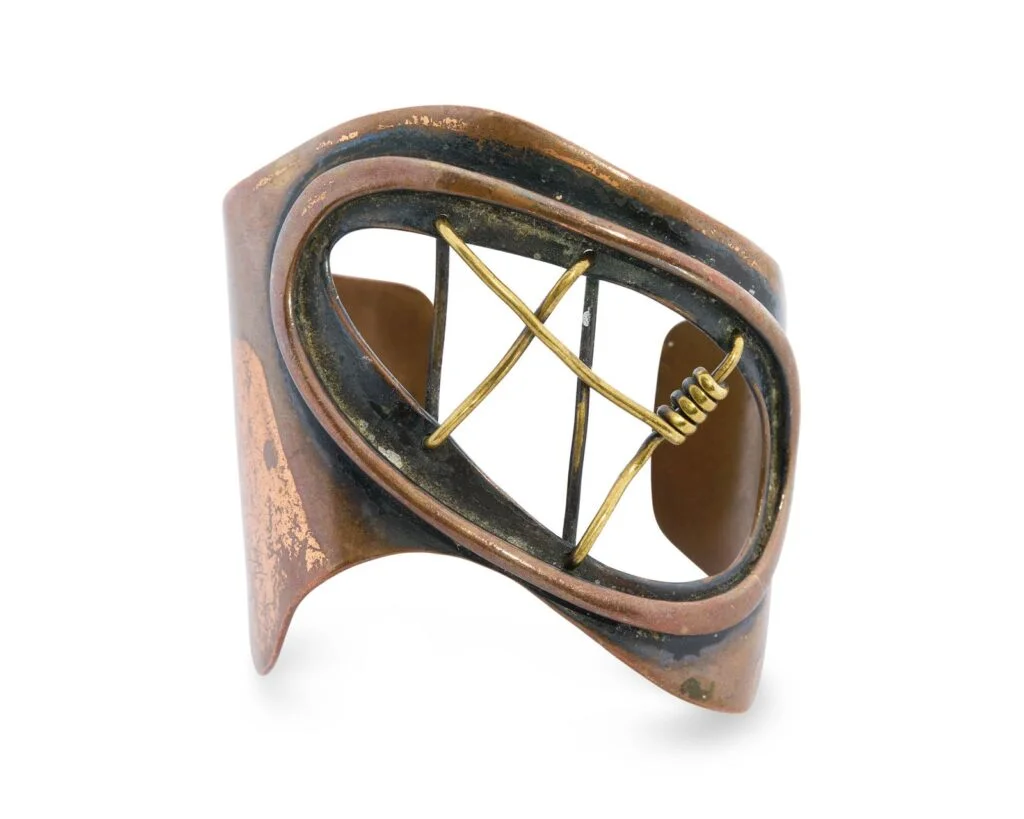
Art Smith’s jewelry stands out because it treats the body as part of the design. Spirals, orbs and kinetic forms weren’t simply ornaments to wear; they shaped how each piece related to the person wearing it. That approach brought Smith attention during his lifetime and has kept his work in museum collections and exhibitions since his death in 1982.

A recent book, Bodyworks: The Jewelry of Art Smith by Joanne Hyppolite and Toni Greenbaum (Smithsonian Books, 2026), presents his work alongside its sources of inspiration. The National Museum of African American History and Culture honors Smith through this publication, which connects his designs to African culture, modern dance and the work of other artists, including Harry Bertoia. Smith’s career spanned the late 1930s through the 1970s.
Greenwich Village and a sculptural approach
Smith immigrated from Cuba with his family in the 1920s, but described himself as a New Yorker born in the city. New York became central to his artistic life. A scholarship at Cooper Union for the Advancement of Science and Art helped him develop his sculpting skills. He also learned about jewelry through the example and guidance of Winifred Mason.
Smith opened his own business in Little Italy in 1946, then moved his studio to Greenwich Village, where he worked through 1979. Nearby artists included Sam Kramer, Francisco Rebajes and Mason. The neighborhood’s jazz clubs, Surrealism and the moving forms of Alexander Calder all contributed to the creative surroundings that informed his work.

Smith paid close attention to the people who wore his jewelry. He called necklaces “neck pieces” and rings “hand decorations,” language that puts the emphasis on how a design meets the body. His sketches became works in gold, silver, aluminum, copper and brass. Using a range of metals helped make the designs accessible to customers with different budgets, a lesson he drew from working alongside Mason. Quartz, turquoise, agate and tiger’s eye supplied occasional color.
His own shop was one route to buyers; Bloomingdale’s and boutiques around the United States also carried his work. Vogue and Harper’s Bazaar featured his designs in the early 1950s. Customers returned to commission individual pieces, including a necklace named for the sister of jazz bandleader Duke Ellington. Smith’s work appeared in several exhibitions during the 1960s, including a solo show at the Museum of Contemporary Crafts.
His reputation continued to grow after his death. His life partner and heir, Charles Russell, donated Smith’s jewelry collection to The Brooklyn Museum of Art. The museum’s From the Village to Vogue: The Modernist Jewelry of Art Smith brought together adornment, ephemera and other items from the estate. The touring exhibition also appeared at the High Museum of Art in Atlanta, Georgia, and other venues. Museums across the United States hold Smith jewelry in their permanent collections.

in sterling silver.
Names and dates can take research
Some designs had names from the start. Smith named the Lava cuff and Half & Half necklace, while the Baker cuff took its name from jazz singer Josephine Baker. Several designs appeared in a store catalog he published in the 1950s. Other names came later: Russell used some in Art as Adornment: The Life and Work of Arthur George Smith (Outskirts Press, 2015), drawing on what he learned during the last eight years of Smith’s life. Names for some commissioned pieces may have been lost.
Dating a signed piece precisely is often difficult. The store catalog and museum exhibition notes can help connect a design to a period, but they don’t always establish when a particular object was made. Broad dates such as the 1950s or 1960s are common, even in museum descriptions. Collectors should treat a specific year as uncertain unless documentation supports it.

Materials and marks for collectors
Interest in Smith’s work means even modest pieces can attract strong attention. The source describes small copper works and some small sterling brooches selling in the hundreds, while many pieces sell in the thousands. The “Simplicity” necklace was popular in the 1960s; Smith’s workshop made it in gold or silver with a single polished, orb-shaped gem, including rutilated quartz or carnelian. Copper cuffs and silver rings can also exceed a thousand dollars, and exceptional pieces may bring more.
Those figures are a snapshot of the market described in the source, not a guarantee for any particular object. Condition, materials, design and identification all matter. Smith stamped sterling silver and gold pieces with the metal designation near the studio mark; lesser metals weren’t identified in the same way. A mark is a useful clue, but dating and naming still benefit from comparison with catalogs, museum records and well-documented examples. A previously overlooked piece can reward careful identification.
For comparable past sales, collectors can consult the WorthPoint Price Guide. More examples and price records are available through WorthPoint.
| Rev | Description | Date |
|---|---|---|
| A | Issued for reading | |
| B | Viewed 523 times | Current |