From Wilbur Buds to Topps: Candy Makers Built Baseball Card Collecting
- Project
- Coins & Currency
- Drawn by
- Glenn Renick
- Issued
- Sheet
- A-205
Philadelphia candy makers helped shape baseball cards, from early E-cards to the gum packs that brought Bowman, Fleer and Topps into the hobby.

The story of baseball cards starts with candy makers who treated cardboard as a way to sell sweets. Across Philadelphia and nearby towns, rival companies tested different products and card subjects, then carried the idea from caramel and chocolate into gum. Their choices helped establish a pattern collectors still recognize: a card’s maker, product, year and catalog number can tell as much about its origins as the player pictured on it.

Wilbur and Croft split over chocolate
Henry Wilbur came from a stove and hardware business in Vineland, New Jersey. Samuel Croft ran a small candy shop in Philadelphia. After meeting at a train station near the end of the Civil War, they saw an opportunity to sell sweets to people traveling through the city. Croft knew candy making; Wilbur brought manufacturing experience. Their early molasses candies gave way to a wider range of confections, and trade cards became part of their early advertising.
The partners eventually disagreed about the company’s direction. Wilbur saw greater potential in chocolate, while Croft favored sugar based candy. In 1884, they divided the business: Wilbur established H.O. Wilbur & Sons, and Croft joined a new partner to form Croft & Allen. By the early 1900s both firms were distributing cards with their products. Croft concentrated on baseball subjects; Wilbur’s cards generally depicted other topics. One unusual Wilbur baseball card let buyers dress a pictured boy in a baseball uniform and other outfits.
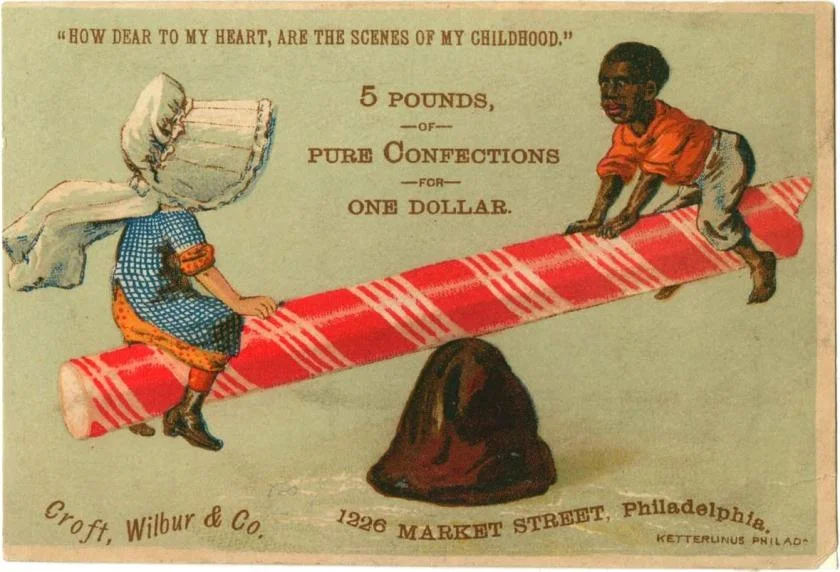

Wilbur’s standout confection was the Wilbur Bud, introduced in 1893. The foil wrapped chocolate bite became the country’s most popular chocolate candy for nearly 30 years, according to the source. Its success, alongside that of Philadelphia chocolatier Stephen Whitman, is believed to have helped inspire Milton Hershey’s move into chocolate.
Caramel companies and a long running set
Hershey had founded the Lancaster Caramel Company in 1886. By 1894, it employed 1,400 people. Convinced that chocolate would lead the candy trade, he formed Hershey’s Chocolate and sold Lancaster Caramel’s assets in 1900. The buyers renamed the business American Caramel Company.
Hershey’s Chocolate began making Hershey’s Kisses in 1907, fourteen years after the Wilbur Bud appeared. Wilbur Buds outsold them until 1921, when Hershey added a paper plume to the wrapper and promoted it as identifying “the original Hershey’s Kiss.” Both candies are still made, though neither now includes cards. Hershey’s chocolate business also issued other E-cards, keeping the company connected to this collecting history.

Several American Caramel executives left to start other firms, including Standard Caramel. Former Hershey employees and American Caramel executives George Breisch and Henry Williams took over the Oxford Caramel factory. Their Breisch-Williams company issued the first E-cards mentioned here, then developed into Williams Caramel and Oxford Confectionery. Each name appeared on products that included baseball and other trading cards.


American Caramel grew into the largest caramel producer in the United States and issued more E-card sets than any other company, including nine E-baseball sets. Yet the longest running and largest E-set came from Collins-McCarthy Candy Company in San Francisco. From 1911 through 1938, the company repeatedly placed a baseball card in each Zee-Nut bar. The run extended into the R-card era and produced more than 3,000 different cards, classified by Jefferson Burdick as E137.

Philadelphia Caramel followed the public’s interests
Jacob Schleicher founded Philadelphia Caramel Company after coming to the United States to introduce a practical gas engine at the 1876 Centennial World’s Fair. Once he sold his engine franchise, he learned that Hershey was shifting from caramel toward chocolate. Schleicher set out to combine the two in candy, and used cards to promote the business.
The company’s subjects reflected different interests of the period. It issued zoo cards, drawing on Philadelphia’s large zoo; Indian cards, amid public interest in the West; an airship series four years after the Wright brothers’ first flight; and prizefighter cards after learning that Theodore Roosevelt enjoyed boxing. Baseball joined the lineup in 1909, as the Athletics competed with Detroit for the American League pennant, and again in 1910, when the A’s went on to win the World Series.

That range of subjects shows how confectioners matched cards to the people they hoped would buy their products. Baseball was one popular choice, but not the only one. Its staying power is the striking part: the game remained a fixture of candy and gum cards, and later of trading cards sold without gum.
Fleer and the move from candy to gum
Frank H. Fleer Corporation is missing from Burdick’s American Card Catalog coverage of the E-card era, despite its baseball cards. Fleer established his Philadelphia candy company in 1885. Early chewing gum sales were limited, but he developed Chiclets, a chicle based gum covered in a candy shell, which achieved broad distribution.
Fleer later sold gum with different flavored coatings under names including peppermint Bobs and fruit flavored Fruit Hearts. In 1923, baseball cards appeared in boxes of both products. In 1928, Fleer employee Walter Deimer developed the first commercially successful bubble gum, sold as Double Bubble. It became popular without cards as a promotional extra.


Jacob Warren Bowman also started a Philadelphia gum company, Gum, Incorporated, whose bubble gum was called Blony. In 1933, the company put “Wild West Series” and “Pirates Pictures” cards in Blony. That year, World Wide Gum in Canada and its United States subsidiary Goudey in Boston introduced themed gum packs containing baseball and other cards. DeLong Gum Company and George C. Miller Candy Company also issued baseball cards. Burdick classified some of these gum, candy and food inserts among the R-cards.

Goudey baseball cards found a strong audience when they appeared and remain popular with collectors. The company’s success caught the attention of Gum, Inc., which began including Play Ball Gum baseball cards in 1939. Goudey and Play Ball both issued cards until World War II began. Goudey later continued selling gum but made no more cards.
Gum, Inc. became Bowman Gum Company and initially aimed its advertising at returning GIs. By 1948, Bowman was again focusing on children, with sports cards packaged alongside gum.

Topps changes the competition
Fleer’s Dubble Bubble continued to sell well, but a new gum maker was entering the contest. In Brooklyn, the owners of American Leaf Tobacco and American Gas Stations changed course in 1938, left tobacco and gasoline sales, and formed Topps. Its signature product was Bazooka Bubble Gum.

Topps began putting cards in its gum in 1948. In 1956, it bought Bowman, removing a major competitor and ending Blony gum. Fleer returned with several card sets in 1959, including the Ted Williams set, as it tried to keep pace with Topps. The competition had grown from candy makers using cards to promote sweets into a contest for a larger share of the trading card business.

Topps bought Bowman in 1956. Cards eventually became products in their own right, and limited editions became extras included with other cards. Collectors now often call cards once given away with another product “odd balls.” The route from candy counter to card aisle is not a straight line, but the early Philadelphia makers remain central to it.

The catalog record below gives collectors a useful map of early candy and gum sets. It lists 49 sets across the locations shown, with 25 attributed to the Keystone Strip, meaning Philadelphia and surrounding areas. The longest span in the list belongs to Collins-McCarthy’s Zee-Nut issue, E137, dated 1911–38. The compiler excludes the 1888 E223 Green & Blackwell Chewing Gum set because the company did not exist in the 20th century and the cards predated the Dingley Act.

Early candy and gum sets in the American Card Catalog
| Year | Catalog | Company or product | Location |
|---|---|---|---|
| 1903–4 | E107 | Breisch-Williams | Oxford, PA |
| 1908 | E91-A | American Caramel Co. | Lancaster, PA |
| 1909 | E91-B | American Caramel Co. | Lancaster, PA |
| 1909 | E92-1 | John H. Dockman & Son, Inc. | Baltimore, MD |
| 1909 | E92-2 | Croft & Allen Candy Co. | Philadelphia, PA |
| 1909 | E92-3 | Croft & Allen Cocoa Co. | Philadelphia, PA |
| 1909 | E92-4 | Blake-Wenneker Candy Company (Nadja) | St. Louis, MO |
| 1909 | E95 | Philadelphia Caramel Co. | Philadelphia, PA (Camden, NJ) |
| 1909 | E97 | C.A. Briggs Lozenge Makers | Boston, MA |
| 1909 | E101 | Anonymous | Unknown |
| 1909 | E102 | Anonymous | Unknown |
| 1909 | E254 | Colgan Gum Company | Louisville, KY |
| 1909–11 | E90-1 | American Caramel Co. | Philadelphia (Lancaster), PA |
| 1910 | E90-2 | American Caramel Co. | Philadelphia (Lancaster), PA |
| 1910 | E90-3 | American Caramel Co. | Lancaster, PA |
| 1910 | E91-C | American Caramel Co. | Lancaster, PA |
| 1910 | E93 | Standard Caramel Co. | Lancaster, PA |
| 1910 | E96 | Philadelphia Caramel Co. | Philadelphia, PA (Camden, NJ) |
| 1910 | E98 | Unverified, appears to be Standard Caramel Co. | Lancaster, PA |
| 1910 | E99 | Bishop & Company | Los Angeles, CA |
| 1910 | E103 | Williams Caramel Co. | Oxford, PA |
| 1910 | E104 | Blake-Wenneker Candy Company (Nadja) | St. Louis, MO |
| 1910 | E105 | Texas Gum Company (Mello Mints) | Temple, TX |
| 1910 | E125 | American Caramel Co. | Lancaster, PA |
| 1910 | E222 | AWH Caramel Co. | Richmond, VA |
| 1910 | E221 | Bishop & Company (Team Cards) | Los Angeles, CA |
| 1910 | E271 | Darby’s Chocolate Company | Baltimore, MD |
| 1910 | E286 | AMM Candy Co. (Ju-Ju Drums) | Unknown |
| 1911 | E100 | Bishop & Company | Los Angeles, CA |
| 1911 | E94 | Close Candy Co. | Cambridge, MA |
| 1911–38 | E137 | Collins-McCarthy Candy Co. (Zee-Nut) | San Francisco, CA |
| 1912 | E270 | Colgan Gum Company | Louisville, KY |
| 1912 | E136 | Collins-McCarthy Candy Co. (Home Run Kisses) | San Francisco, CA |
| 1912 | E300 | Plow’s Candy Co. | St. Louis, MO |
| 1914 | E145-1 | Rueckheim Bros. & Eckstein Co. (Cracker Jack) | Chicago, IL |
| 1914 | E224 | Cardinet Candy Co. (Texas Tommy) | Oakland, CA |
| 1915 | E106 | American Caramel Co. | York, PA |
| 1915 | E145-2 | Rueckheim Bros. & Eckstein Co. (Cracker Jack) | Chicago, IL |
| 1917 | E135 | Collins-McCarthy Candy Co. | San Francisco, CA |
| Circa 1920 | E268-5 | H.O. Wilbur & Sons (Little Will-Burr) | Philadelphia (Lititz), PA |
| 1921 | E253 | Oxford Confectionary | Oxford, PA |
| 1921–22 | E121 | American Caramel Co. | Lancaster, PA |
| 1921–23 | E220 | National Caramel | Lancaster, PA |
| 1922 | E120 | American Caramel Co. | Lancaster, PA |
| 1922 | E122 | American Caramel Co. | Lancaster, PA |
| 1223 | E123 | Curtis Ireland Candy Corporation | St. Louis, MO |
| 1927 | E126 | American Caramel Co. | Lancaster, PA |
| 1927–28 | E210 | York Caramel Co. | York, PA |
| 1933 | E285 | Rittenhouse Candy Co. | Philadelphia |
| Sets | Locations |
|---|---|
| 25 | Keystone Strip (Philadelphia and surrounding area) |
| 2 | Baltimore |
| 4 | St. Louis |
| 2 | Massachusetts |
| 2 | Louisville |
| 7 | California |
| 1 | Texas |
| 1 | Virginia |
| 2 | Chicago |
| 3 | Unknown |
| 49 | Total |
The source lists the Curtis Ireland Candy Corporation E123 year as “1223.”
===| Rev | Description | Date |
|---|---|---|
| A | Issued for reading | |
| B | Viewed 392 times | Current |